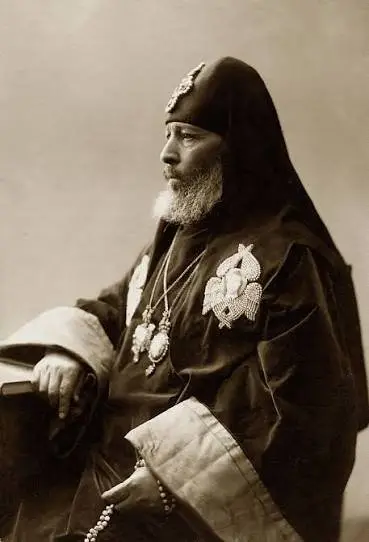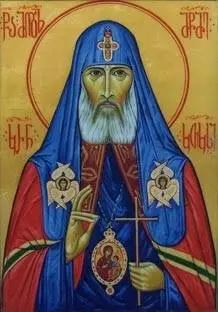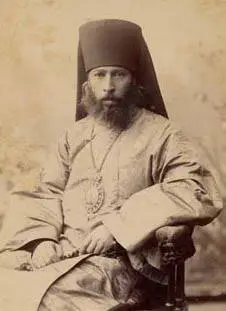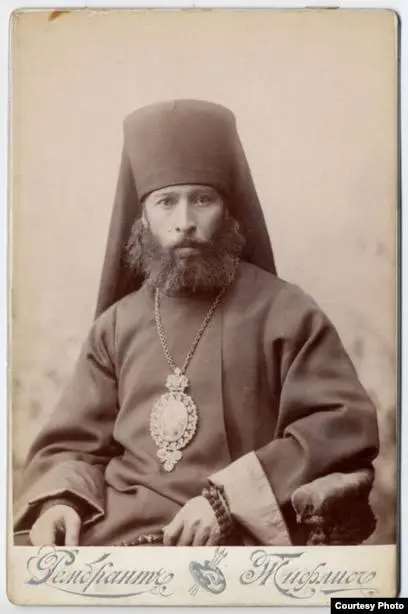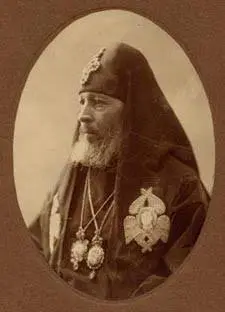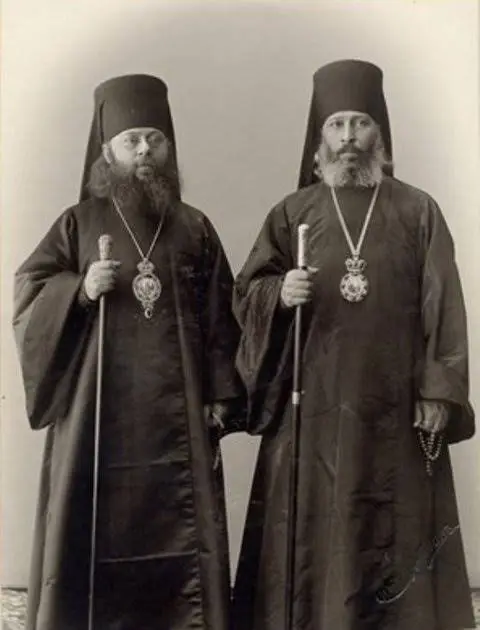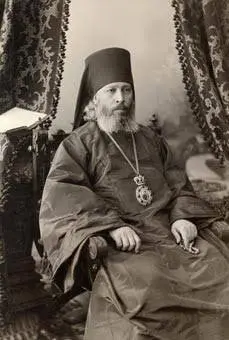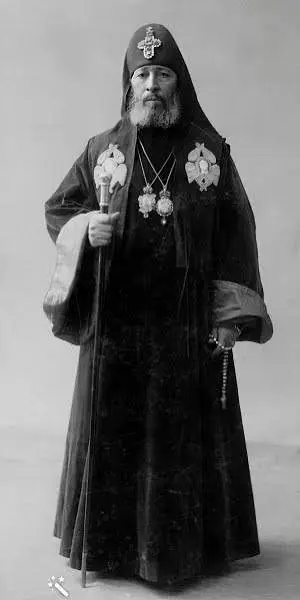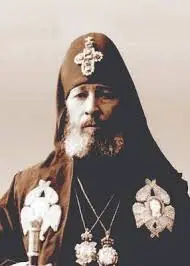
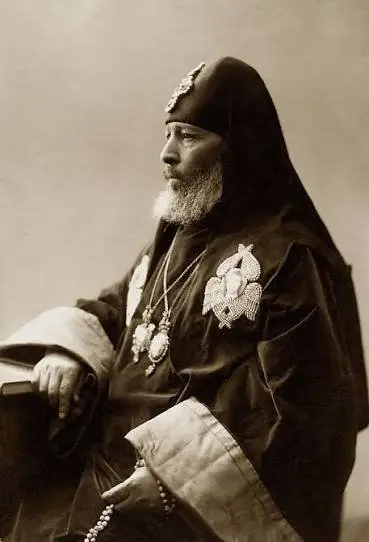
Patriarch Kirion II, first shepherd of regained freedom
For years he looked at his homeland from afar and kept his bond with it in books, letters and manuscripts. When at last he returned, Svetitskhoveli received the first shepherd of the free Church. Time left him little, but his legacy remained: books saved, young people formed, and a Church that once again prayed with its own voice. So freedom returned, first as prayer and then as a great hope.
After more than a century of silence the Church of Georgia once again elected its own primate. At this historic threshold stood Kirion II, a scholar, teacher and persecuted bishop, in whose life love of the homeland was joined to faith. His patriarchate proved brief, but behind it lay decades of work, loss and waiting. He returned to a country that had just restored freedom to the Church and that also stood on the threshold of state independence.
Kirion II, in the world Giorgi Ieronimes dze Sadzaglishvili, was born on 10 November 1855 in the village of Kvemo Nikozi in the Gori district, into a clergy family. His childhood surroundings made him a sharer in the life of the Church. He began his education at the school attached to Ananuri monastery and continued it at the Gori theological school.
In 1876 Giorgi graduated from the Tbilisi Theological Seminary and continued his studies at the Kiev Theological Academy. In 1880 he received the degree of candidate of theology. The education he received at the Academy included both theology and disciplines related to history. He then worked as assistant inspector at the Odessa Theological Seminary. The knowledge gathered before returning home he later devoted to Georgian education and research into church history.
In 1883 Giorgi returned to Georgia. At various times he worked at the theological schools of Telavi, Gori, Kutaisi and Tbilisi. Teaching was not merely an official duty for him: he cared about opening schools, making books accessible and educating young people. The founding of parish schools in Georgia's highlands is linked with his work.
Alongside teaching Giorgi Sadzaglishvili engaged in scholarly work. He published articles in Georgian and Russian journals on the history of the Church of Georgia, literature and folklore. He also used pseudonyms, among them Iverieli and Nikozeli. His interests were wide: old manuscripts, coins, church inscriptions and historical documents were for him sources for studying the past. Seeking out these materials preserved for future generations a heritage rescued from oblivion.
In 1896 a heavy family tragedy struck his life: his wife and child died. The same year he was tonsured a monk and given the name Kirion. The choice of monastic life was a personal decision made after this loss. Appointed superior of the Kvatakhevi monastery, he continued his research and also cared for the protection of manuscripts.
In 1898 Kirion was consecrated Bishop of Alaverdi. He cared for the repair of Alaverdi Cathedral and for the study and protection of the church antiquities of Kakheti. In 1901 he became Bishop of Gori. Schools, libraries and reading rooms held an important place in his practical work. For him a bishop's ministry also included educating the faithful, because knowledge of church history and the mother tongue served to preserve national self-awareness.
Kirion cooperated with the church museum and with the Society for the Spreading of Literacy among Georgians. He handed over to their collections the manuscripts and antiquities he found. He also promoted the scholarly study of the Koridethi Gospels. He helped young Georgians financially to obtain an education. For him protecting the past and preparing the future were two sides of one task: saving an old book had meaning also when the new generation could read and understand it.
The main direction of his public work became the restoration of the autocephaly of the Church of Georgia. He demanded, with historical and canonical arguments, the return of the self-government abolished in 1811. In 1906 he took part in the deliberations held in Saint Petersburg and defended the rights of the Georgian Church. He was not alone in this movement: together with Leonide Okropiridze and other like-minded people he worked for the common goal. For him autocephaly meant that the Church would be governed under its own responsibility.
Conflict with the civil and church authorities of the Russian Empire brought frequent transfers and restrictions into his life. He served in various eparchies outside Georgia; for a time he also headed the see of Sukhumi. Being far from his native surroundings made his work harder, but he did not stop being interested in Georgian history. He kept in touch with his allies by letter, worked on his writings and continued to search for historical traces connected with Georgian culture.
In 1908, after the murder of Exarch Nikon in Tbilisi, accusations against the supporters of autocephaly intensified. Kirion too was linked with this crime, though the accusation of his involvement cannot be regarded as a proven fact. He was deprived of the possibility of church governance and placed under strict surveillance. The years spent in the Sanaksar monastery and then in Kherson were a hard stretch of his life. People spoke out in his defence both in Georgia and abroad.
Under persecution Kirion continued his research. In 1910 he published a work on the cultural role of Iberia in the history of Russia. In 1915 the right to govern an eparchy was restored to him and he was given the eparchy of Polotsk and Vitebsk. At that time he still had no permission to return to Georgia; meeting his homeland again remained a hope.
The February Revolution of 1917 changed the political order of the Russian Empire. On 12 March, Old Style, the restoration of the autocephaly of the Church of Georgia was proclaimed in Svetitskhoveli. The provisional administration was headed by Leonide, while Kirion was still outside the country. His Georgian allies worked for his return, and the same year he came to Georgia. For many people his return expressed the end of a long separation and the hope of the Church's renewal.
In September 1917 the First Church Council elected Kirion II Catholicos-Patriarch of All Georgia. On 1 October, New Style, his enthronement took place in Svetitskhoveli. He became the first patriarch after the restoration of autocephaly. Beyond the solemn day lay difficult tasks: setting up the Church's governance, regulating the work of the eparchies and restoring international relations. After electing its primate the Church was taking the first steps of independent life.
Kirion wrote to the heads of other Churches and asked for recognition of the autocephaly of the Church of Georgia. The leadership of the Russian Church did not agree with the way restoration had been carried out, so relations remained tense. There were difficulties within the Church too: after the elections personal conflicts and disagreements did not end. Describing his leadership only as a solemn picture would be incomplete. Together with freedom, the restored Church was given the responsibility of preserving unity.
On 26 May 1918 Georgia declared its state independence. Kirion lived to see the event towards which the national movement had moved for years. Yet his ministry in the independent state lasted only a few weeks. At the end of June he was found dead in the patriarchal residence at Martkopi monastery. According to the most widespread account, he was found on the morning of 27 June; some sources give 26 June as the date of his death. This discrepancy calls for a careful reading of the sources.
His death became established in Georgian church memory as a murder and a martyr's end. Yet the identity of the culprit and the full circumstances of what happened have never been definitively established. The existence of various hypotheses does not give us the right to attribute unproven guilt to specific persons. The patriarch was buried in Sioni Cathedral in Tbilisi. Leonide then took over the leadership of the Church. Kirion's death marked the first years of the restored Church with a heavy loss.
On 17 October 2002 the Holy Synod of the Church of Georgia canonised Kirion II. He is commemorated as a hieromartyr. His memory unites service to the faith, scholarly work, support for education and the struggle for autocephaly. In his life victory and pain cannot be separated. Having returned home, he managed only a brief primacy, but the books he protected, the young people he strengthened and the work done for the restored Church remained as a legacy that death could not erase.