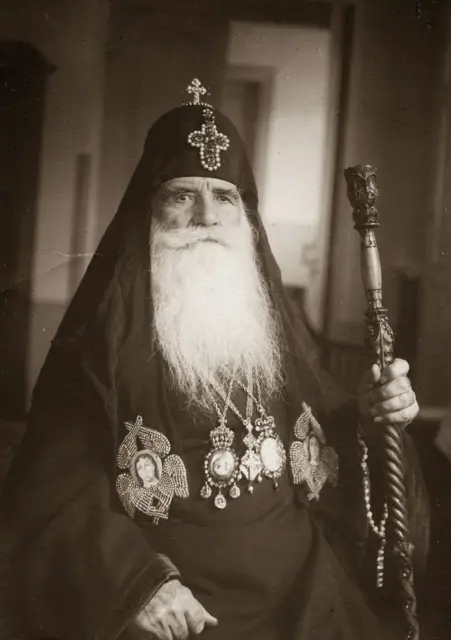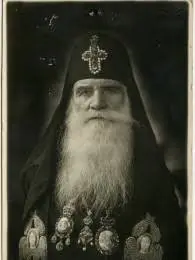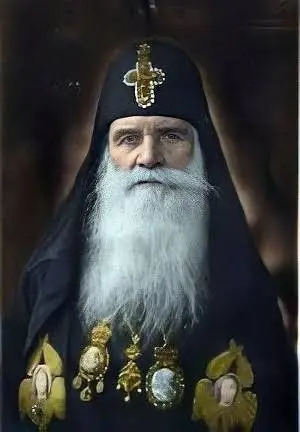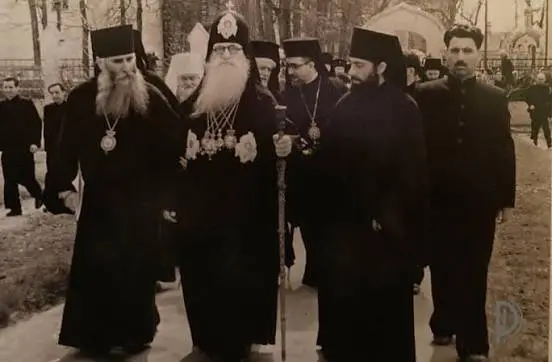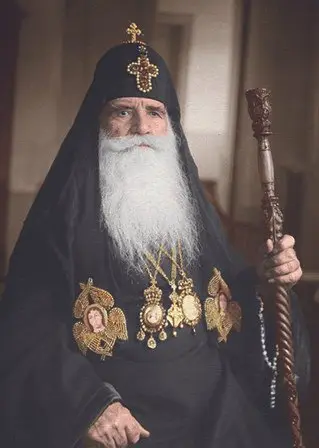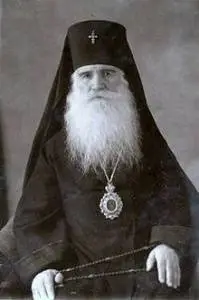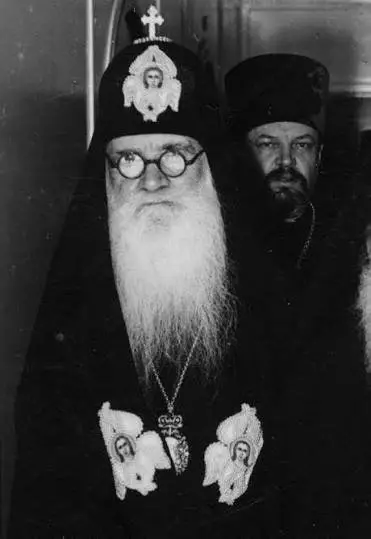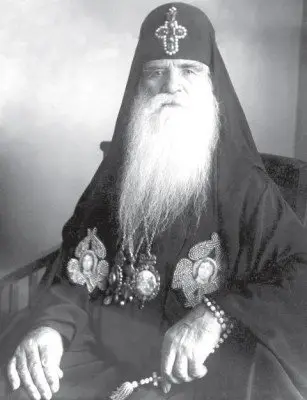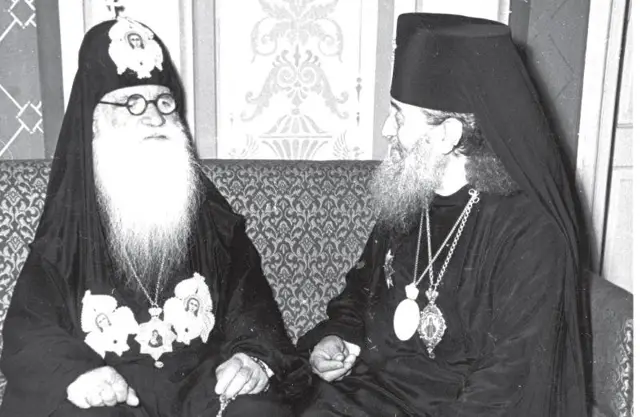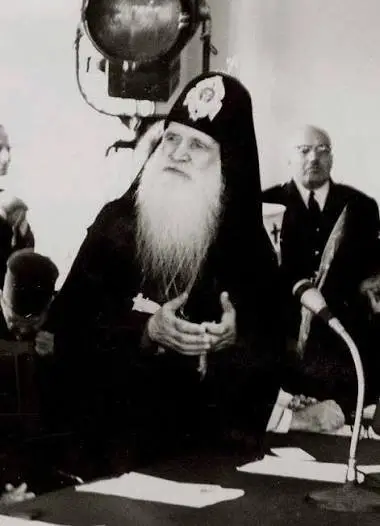
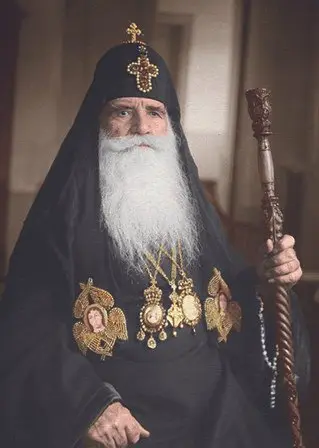
Melchizedek III, Catholicos-Patriarch of All Georgia
He divided his life between book and prayer, and served both with equal devotion. At Bodbe the tomb of Saint Nino regained its light through his hand, and in Sioni Georgian chant was heard again after years of silence. His legacy is twofold: one part is kept in the walls of the church, the other in the pages where the voice of Herodotus sounds in Georgian.
On 5 April 1952 the Church of Georgia elected Metropolitan Melchizedek as its new primate. Patriarch Kalistrate had died shortly before, and the Church still had to live under the strict control of the Soviet state. Many practical and spiritual concerns lay before the new Catholicos-Patriarch. He had to care for the churches, the clergy and the people for whom the Church remained a place of faith and of Georgian spiritual memory.
Melchizedek III, in the world Mikheil Giorgis dze Pkhaladze, was born on 2 November 1872 in the village of Zemo Kandaura in the Sighnaghi district. The path of his life was linked with theological education from his early years. He studied at the Telavi theological school and then at the Tbilisi Theological Seminary, from which he graduated in 1896.
During his studies in Tbilisi he mastered ancient Greek and philosophy. The desire to continue his education took him to the Kazan Theological Academy. In 1900 he graduated from the Academy and received the academic title of candidate of theology. This knowledge did not remain only his personal achievement: he began to teach and devoted many years to the education of young people.
The Tbilisi Seminary and the Kazan Academy were in very different settings, but in both study held the central place for him. Later his interests went beyond theological subjects and extended to historical texts. That is why at the beginning of his biography we see not only the future patriarch but a man who made acquiring and sharing knowledge his life's work.
He first worked at the Kutaisi theological school and then taught at theological schools in various cities of the Russian Empire. Teaching was not a chance episode in his biography. In the years when future clergy were choosing their path, Mikheil shared his knowledge with them. Later, when he stood at the head of the Church, this experience would be an important part of his life.
In 1915 Mikheil Pkhaladze was ordained priest. From 1917 he served at the Gori theological school. The same year the Church of Georgia restored its autocephaly. After this historic event the clergy faced the task of organising the life of their own Church. Mikheil too continued his ministry in these transitional years.
In 1918 he was given the rank of archpriest. At that time the Church of Georgia, after the restoration of autocephaly, was trying to organise its own life, and the country's political future was still uncertain. Mikheil's ministry went on against the background of these events. Soon the establishment of Soviet power brought new obstacles before the Church, which the clergy had to cope with for many years.
In 1922–1924 he served as a priest in Sioni Cathedral in Tbilisi. Praying in this cathedral was not merely a daily duty for him: here he saw at close hand the life of the Church, the needs of the faithful and the changes that in the coming years would weigh even more heavily on the clergy. The historical setting was growing harder, but his ministry continued.
In 1925 he was tonsured a monk and given the name Melchizedek. In October of the same year he was raised to the rank of Bishop of Alaverdi. In 1927 he was entrusted with governing the eparchy of Tskhum-Abkhazia.
In 1928 he was transferred as Bishop of Tsilkani. Later he served at the Monastery of the Transfiguration in Tbilisi. These changes are details of his personal path, but at the same time they show how the Church had to redistribute its forces. The bishop was assigned to serve in various places, while the possibilities of churches and clergy were limited.
Listing these years is simple, but each new place meant people and new responsibility. The bishop had to care for clergy, churches and faithful at a time when the Church had less and less freedom to act. Melchizedek's life no longer fitted within the bounds of a single city or a single church.
In 1935 he received the title of metropolitan and was again appointed to govern the eparchy of Tskhum-Abkhazia. In 1944 he was entrusted with the rectorship of the Didube Church of the Nativity of the Mother of God in Tbilisi and the governance of the eparchy of Urbnisi. Behind him lay decades of teaching and church experience; before him awaited another especially heavy responsibility.
On 5 April 1952, after the death of Patriarch Kalistrate, the Ninth Church Council of Georgia elected Metropolitan Melchizedek Catholicos-Patriarch of All Georgia. He took the head of the Church at an advanced age, yet he still had to bear the new duty with all his strength. In that age the patriarchal throne meant neither peace nor guaranteed possibilities.
Under Soviet power the Church's room for action was limited. The state of the churches, the ministry of the clergy and the church life of the faithful met with many obstacles. In such an environment the primate had both to solve daily problems and to protect what the Church of Georgia had received over the centuries.
During his patriarchate the Church had to care both for current needs and for preserving its historical heritage. That is why the decisions concerning the church, Georgian chant and the relics of saints should not be read separately. Each of them touched on the question of how the Church's life would continue in an environment where it could not act freely.
The restoration and renewal of the church over Saint Nino's tomb at Bodbe is linked with the name of Melchizedek III. This place is especially precious for the Christian history of Georgia. Caring for it was not merely putting a building in order: it was honouring a holy place that many generations connected with the name of Saint Nino.
The transfer of the relics of Saints David and Constantine from the museum to Motsameta is also linked with his name. Returning holy objects of history to their place in the church space had special significance in the conditions of that time. This event clearly shows one of the main concerns of Melchizedek's patriarchate: that the heritage of the past should remain part of the Church's living life.
In Sioni in Tbilisi, after a long interruption, Georgian worship and Georgian chant were again established. When prayer is heard in church in the mother tongue, it is not only a matter of language. Word and chant connect people with the faith they received from their ancestors. In the time of Melchizedek III this voice was again given a special place in Sioni.
He did not care only for the administrative affairs of the Church. His education and interests covered many fields: theology, philosophy, history, linguistics and liturgy. His manuscripts bear witness to these wide interests. He translated from Greek the "Histories" of Herodotus and Arrian's "Periplus of the Euxine Sea".
Part of his legacy also remained in his manuscripts. He had a relationship with books from his youth, and in the years of his patriarchate he continued to reflect on church and historical questions. This side is important for getting to know a man we often associate only with the patriarchal throne.
The union of church and scholarly work in one person gives his life a special character. The knowledge gained in youth stayed with him to the end of his life. Teacher, priest, bishop and patriarch are different ministries, but on his path they were not cut off from one another: each was founded on study, work and responsibility towards the Church.
Melchizedek III's patriarchate lasted less than eight years, from April 1952 to January 1960. It was not a long period, but given the difficulties of the time each decision had its weight. The history of the Church is not made only by great events. Sometimes its continuation means that prayer is still offered in church, that a holy place is still honoured and that knowledge of the past is handed on to the next generation.
On 10 January 1960 Melchizedek III died in Tbilisi. He was buried in Sioni Cathedral. After him Metropolitan Ephraim was elected primate of the Church of Georgia, who also had to serve in a difficult age.
If we judge Melchizedek III's life only by the years of his patriarchate, we will not see his long path. From Zemo Kandaura to Sioni in Tbilisi he went through study, teaching, and priestly and episcopal ministry. In different places and at different times one and the same work continued: service to the Church and to people.
His name reminds us that in the hard years of history keeping the faith is often daily work done with patience. Melchizedek III followed precisely such a path. He devoted his care to churches, to prayer in Georgian, to holy places and to education: to what endures longer than one person's life and is handed on to the next generation.