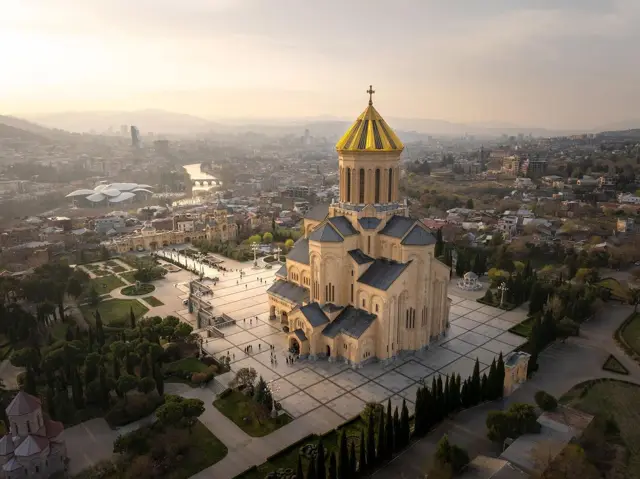
Holy Trinity Cathedral (Sameba)
For nine years stone was laid upon stone, while a nation that had only just regained its freedom built the house of its faith. The dome of Sameba rises towards the sky as though answering all at once every year of silence imposed by the Soviet era. Today, high above Tbilisi, the prayer that was once silenced is heard aloud again.
- Region
- Tbilisi
- UNESCO
- No
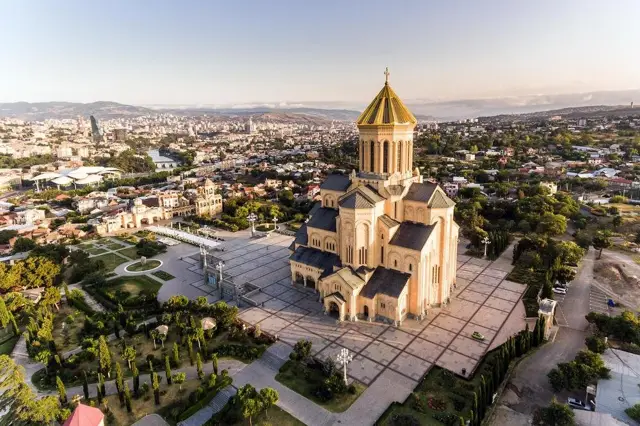
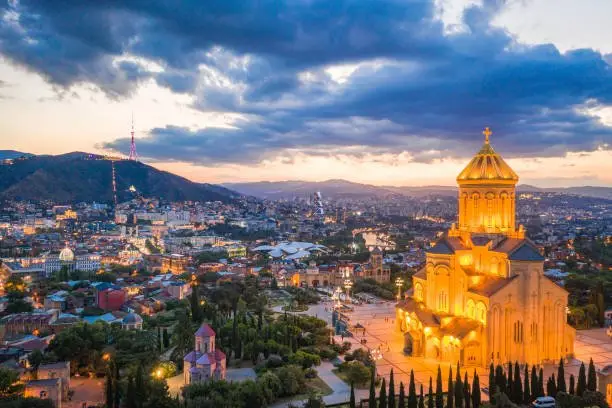
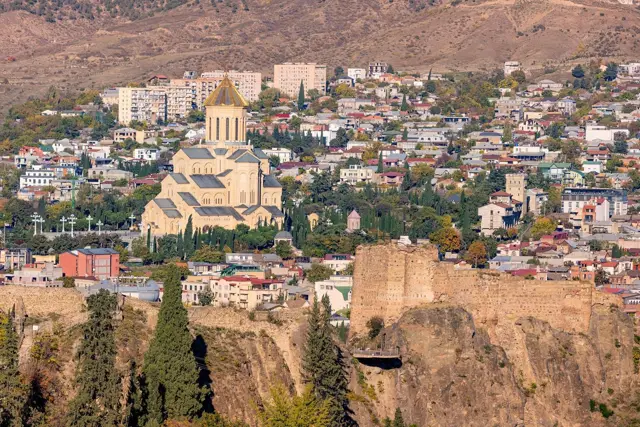
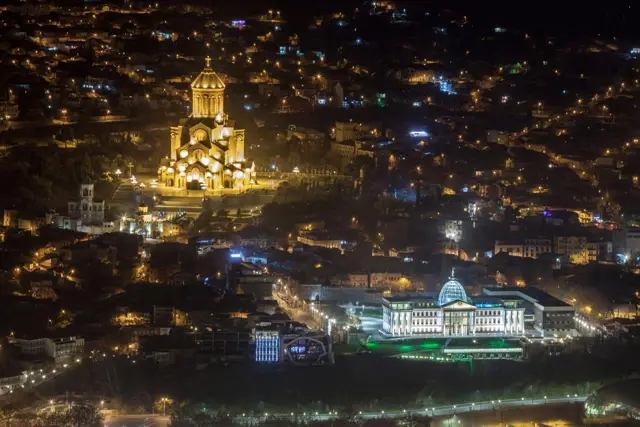
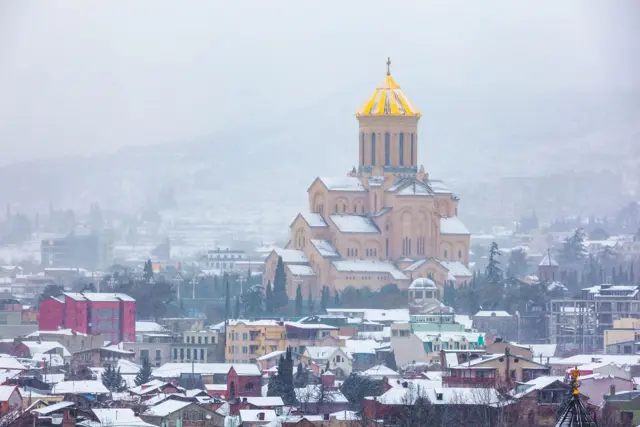
The Holy Trinity Cathedral of Tbilisi, widely known as Sameba, is the main cathedral of the Orthodox Church of Georgia and one of the most important spiritual and national symbols of modern Georgia. Its enormous dome, rising on Elijah Hill, can be seen from almost every part of Tbilisi and is today an inseparable part of the city's skyline.
The idea of building Sameba is linked with a special period in Georgia's history. Throughout the 20th century, under the Soviet atheist regime, the activity of the Church was severely restricted, many churches were closed or used for other purposes, and religious life came under heavy pressure. After the collapse of the Soviet Union and the restoration of Georgia's independence, a broad revival of religious life began in the country.
The idea of building a new cathedral was connected with two important anniversaries: the 1500th anniversary of the autocephaly of the Orthodox Church of Georgia and the 2000th anniversary of the Nativity of Christ. A competition was held to choose the design of the future cathedral, and the project of the architect Archil Mindiashvili won. Thus from the very beginning Sameba was conceived not only as a great church building, but as a symbol linking Georgia's centuries-old Christian history with a new era.
Construction of the cathedral began in 1995. This was an especially difficult period for Georgia: the country faced the political, social and economic problems of the first years of independence. Despite these difficulties, construction went on, with the participation of the Church, various organisations and many citizens. That is why the raising of Sameba was often seen in society as an expression of a shared national and spiritual effort.
The cathedral was consecrated in 2004 and since then has served as the main cathedral of the Orthodox Church of Georgia. Its importance is especially great during church feasts, when thousands of faithful from all over Georgia gather at Sameba.
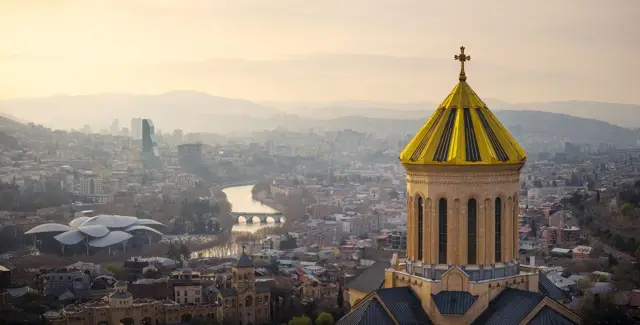
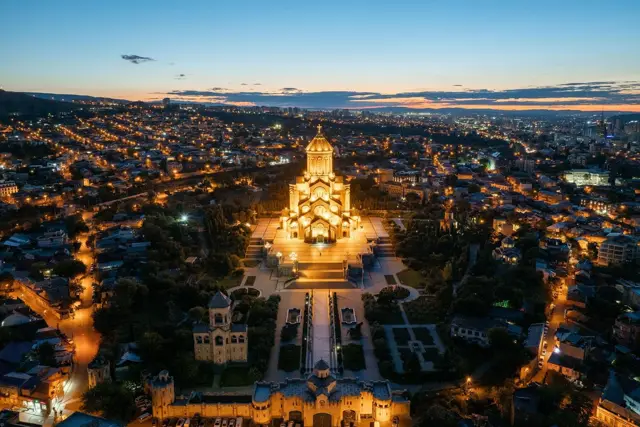
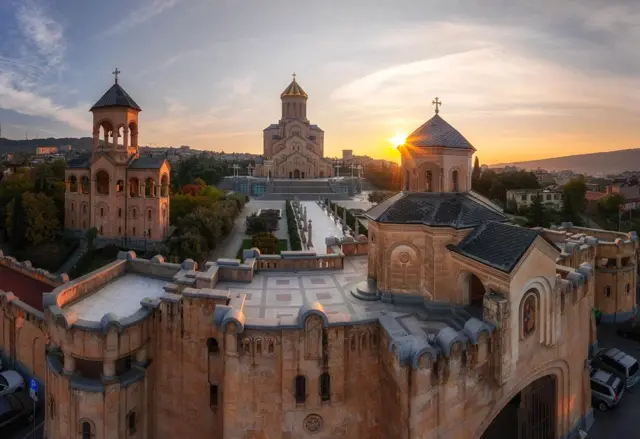
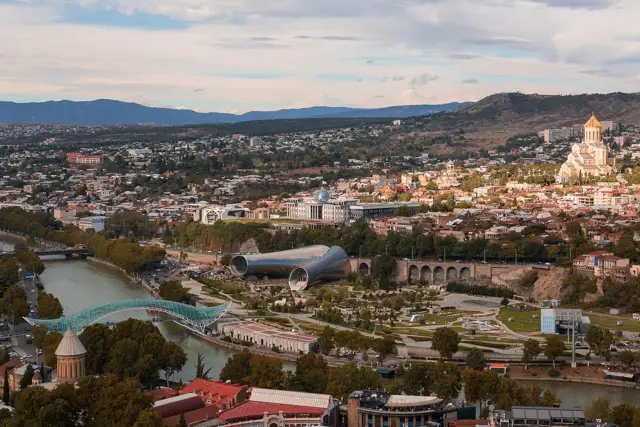
Sameba stands in Tbilisi, on Elijah Hill, on the left bank of the Mtkvari. The height of the site and the scale of the cathedral make it one of the most conspicuous buildings in the city. Its dome and golden cross can be seen from many districts of Tbilisi, and from the cathedral grounds a broad panorama of the city opens out.
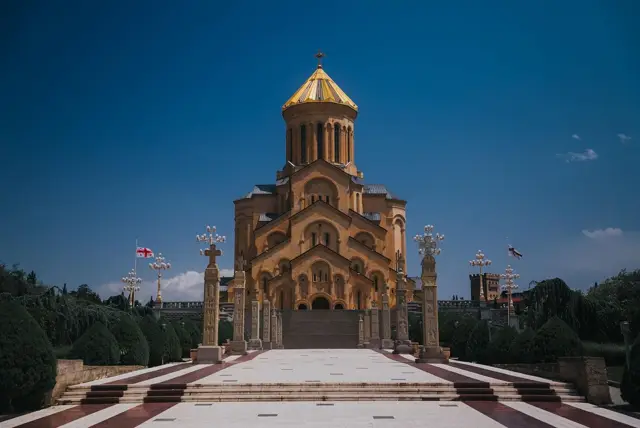
Architecturally, the Trinity Cathedral is a modern building founded on the centuries-old tradition of Georgian church architecture. Its design uses forms characteristic of historical Georgian churches: a monumental dome, a tall central space, stone façades, arched elements and Georgian ornamental decoration. At the same time, its scale and engineering solutions belong to the modern era.
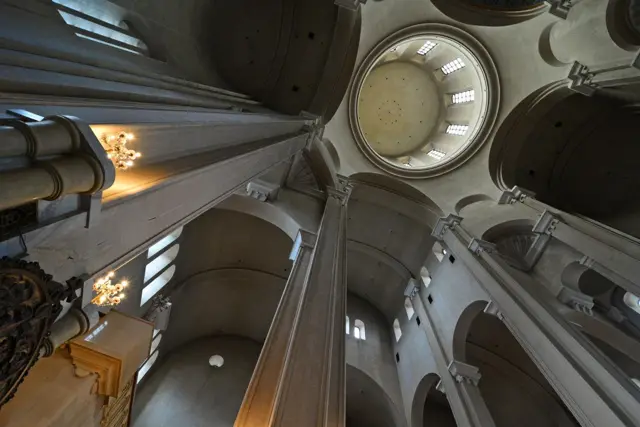
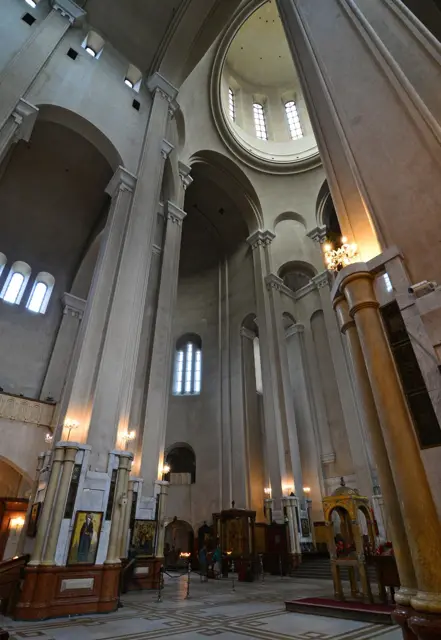
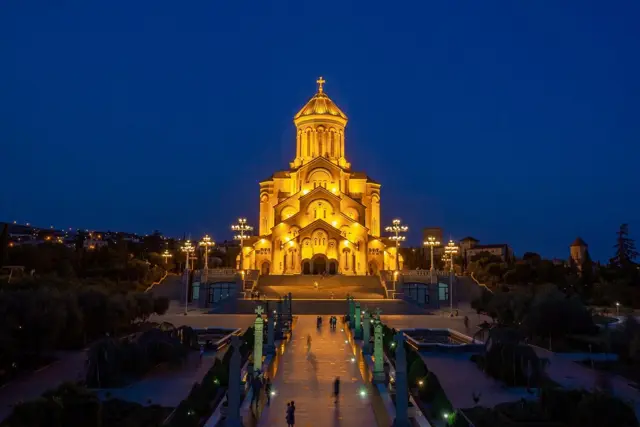
The total height of the cathedral, including the cross, reaches about 87 metres, which is why it is considered one of the tallest Orthodox churches in the world. Its scale is felt especially at the main entrance and on entering the central space, where the high dome and large interior volume create a monumental impression.
The façades of Sameba are faced with stone and decorated with carvings, crosses and ornamental compositions typical of Georgian church architecture. Despite the cathedral's enormous size, the architects sought to preserve the traditional proportions and forms of Georgian medieval architecture in the building's overall appearance.
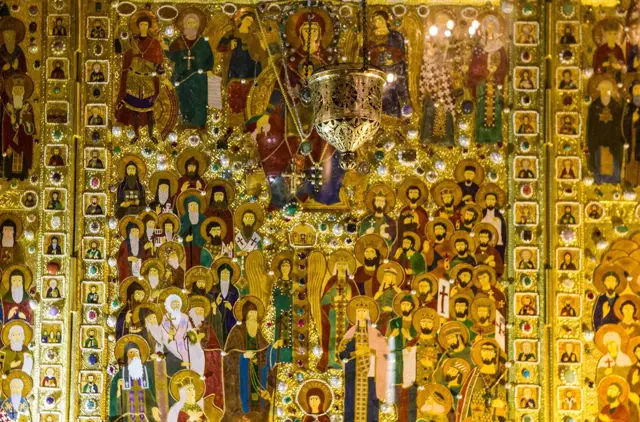
The interior of the cathedral is also remarkable for its scale. The tall central space, the dome, the sanctuary, the icons and the wall paintings create a setting suited to great solemn services. Orthodox iconography and Georgian church art hold a special place in the interior.
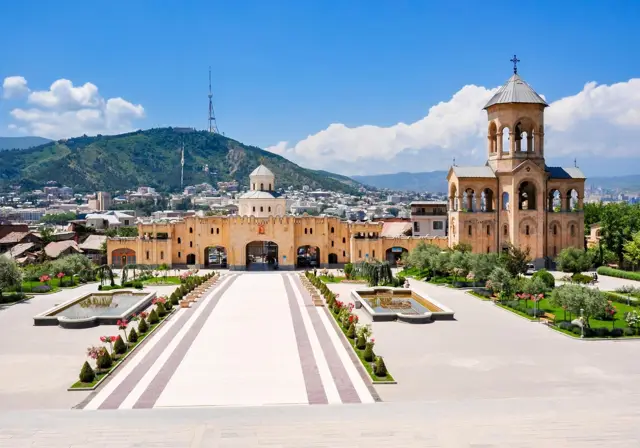
Sameba is not just one church. It is a large church complex which, besides the main cathedral, includes chapels, administrative and ecclesiastical buildings and other spaces. The grounds of the complex are green and include courtyards, gardens and places where pilgrims and visitors can spend time in peaceful surroundings.
Another important feature of the Sameba complex is that the space of the main cathedral extends over several levels, with lower church spaces connected to it. This arrangement further increases the complex's functional possibilities and allows it to host different kinds of church services.
Sameba holds a special place in the present-day life of the Orthodox Church of Georgia. The most important solemn services of the country, the liturgies of Christian feasts and other significant church ceremonies take place here. At Christmas, Easter and other great feasts especially large numbers of faithful visit the cathedral.
The cathedral is closely connected with the ministry and church activity of the Catholicos-Patriarch of All Georgia. Many of the most important patriarchal services and general church gatherings are held here, which makes Sameba one of the main centres of present-day Georgian Orthodoxy.
Besides its religious significance, Sameba also carries deep national meaning. Its construction began after Georgia regained independence, and so for many people the cathedral is linked with the beginning of a new historical stage for the country. Over the centuries the Georgian Church played an important role in preserving national culture, language and historical memory, and in the modern era Sameba has become one of the most visible expressions of that continuity.
The history of Sameba differs from that of Georgia's most ancient churches. Unlike Svetitskhoveli, Jvari, Alaverdi, Bagrati or Gelati, it has no centuries-long medieval past. Its significance lies precisely in being part of the history of modern Georgia: a cathedral created in the period of restored independence, of the revival of Orthodox life and of a new stage of national identity.
At the same time, Sameba forms a kind of architectural bridge between old and new Georgia. Its forms rest on Georgian church architecture shaped over the centuries, while its building technology, scale and functional possibilities belong to the modern era.
Today the Holy Trinity Cathedral of Tbilisi is a functioning Orthodox sanctuary and one of the most important spiritual centres of Georgia. Every day believers come here to pray, and on the great church feasts the cathedral brings together thousands of people.
The Trinity Cathedral is the place where Georgia's centuries-old Christian tradition meets modern history. From the religious restrictions of the Soviet era to the spiritual revival of independent Georgia, the story of its creation reflects an important part of the country's recent past.
Sameba is today one of the main symbols of Georgia's faith, spiritual revival and the continuity of its Christian heritage: a cathedral rising above Tbilisi that in the modern age continues the centuries-old spiritual tradition of the Georgian Orthodox Church.