Vardzia Monastery
The mountain opened its heart to the monks, who with prayer carved out paths where before only the wind had walked. The face of Tamar remained on the wall, adorned with crown and eternity, and when an earthquake split the rock, light saw for the first time what had been kept in silence for centuries to the glory of God.
- Region
- Samtskhe-Javakheti
- UNESCO
- No
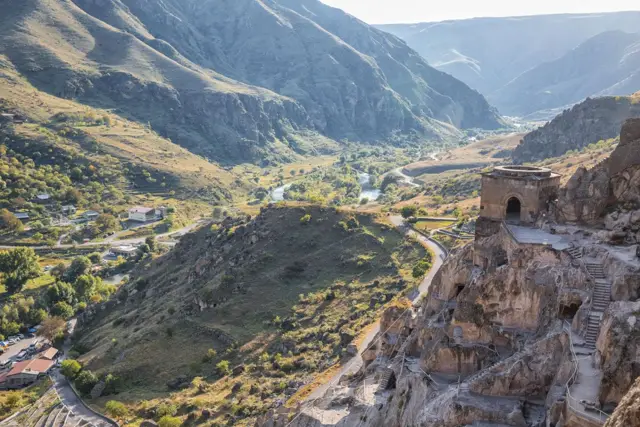
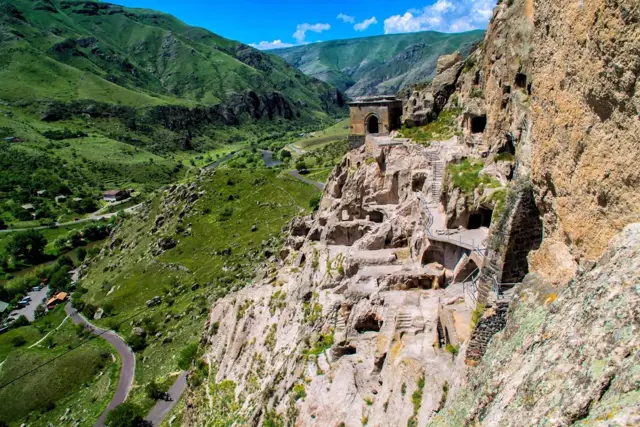
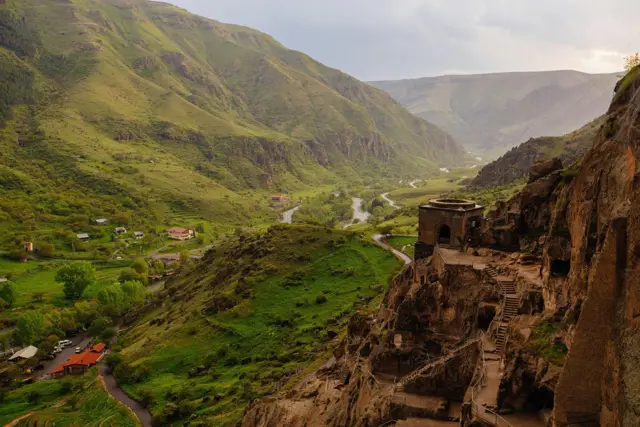
Vardzia Monastery is one of the most outstanding historical, architectural and spiritual monuments of Georgia. It stands in southern Georgia, in historic Meskheti, on the left bank of the Mtkvari, on the rocky slope of Mount Erusheti. Created in the 12th century, this vast complex carved into the rock became one of the most impressive expressions of the strength of Georgia's golden age, of the Orthodox faith, of culture and of engineering knowledge.
The history of Vardzia is especially closely linked with King Giorgi III and Queen Tamar. Its construction began in the second half of the 12th century, during the reign of Giorgi III. This part of southern Georgia had an important strategic position, and the region often faced military danger. A large complex carved into the rock offered both a protected space and the possibility of creating a strong monastic centre.
Vardzia's greatest development came in the age of Queen Tamar. After the death of Giorgi III, Tamar continued the work begun by her father, and the complex became a large-scale monastic centre. It was during her reign that Georgia experienced a political, military and cultural ascent, and Vardzia became one of the visible symbols of this strength.
A well-known folk tradition is also linked with the name of Vardzia. It is said that the young Tamar was in the rock when her uncle was looking for her. Tamar called out: "Here I am, uncle!", in Georgian "ak var, dzia", and folk tradition connected the name "Vardzia" with the joining of the words "var, dzia". It is a beautiful and popular tradition, but it is not regarded as a historically confirmed explanation of the name's origin.
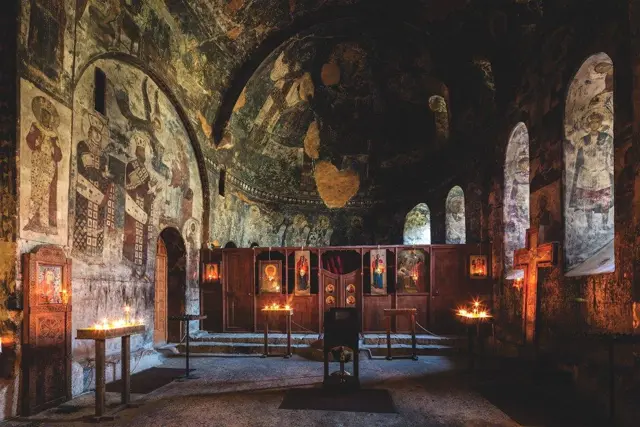
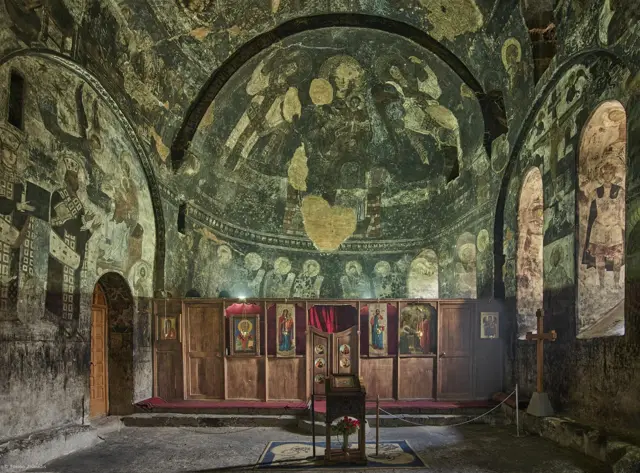
The main spiritual centre of the complex is the Church of the Dormition of the Mother of God. It lies at the heart of the rock-cut monastery and is the most precious part of Vardzia. It was here that the monastery's main services were celebrated, and here outstanding examples of 12th-century Georgian monumental painting survive.
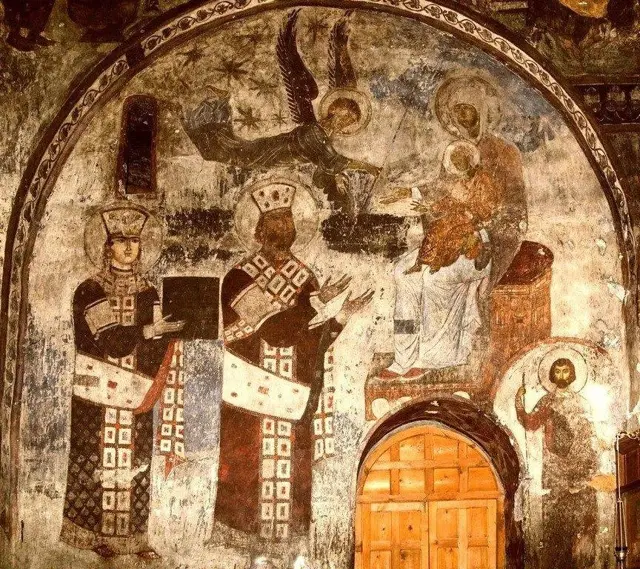
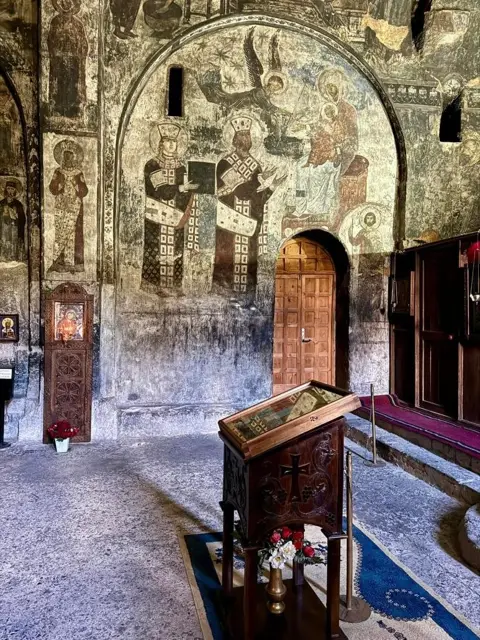
Among the church's frescoes the images of King Giorgi III and Queen Tamar have special historical importance. Tamar is shown in royal robes and a crown. This fresco is one of her most important historical portraits and is of special value both for the history of Georgia and for the study of medieval Georgian art.
Vardzia's wall painting is not limited to the royal portraits. The church contains images of Christ, the Mother of God, saints and various biblical scenes. The frescoes form a unified theological programme and show how high the level of 12th-century Georgian monumental painting was.
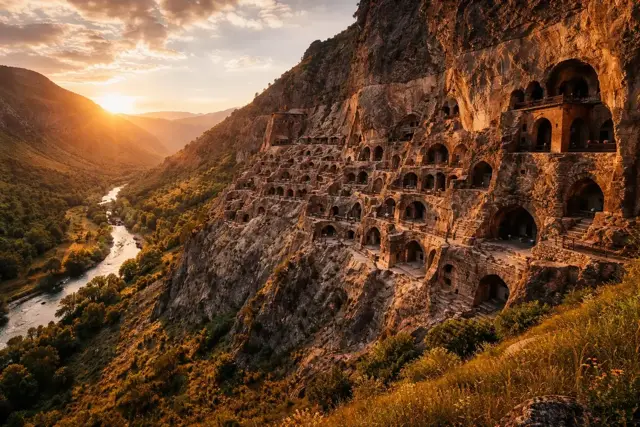
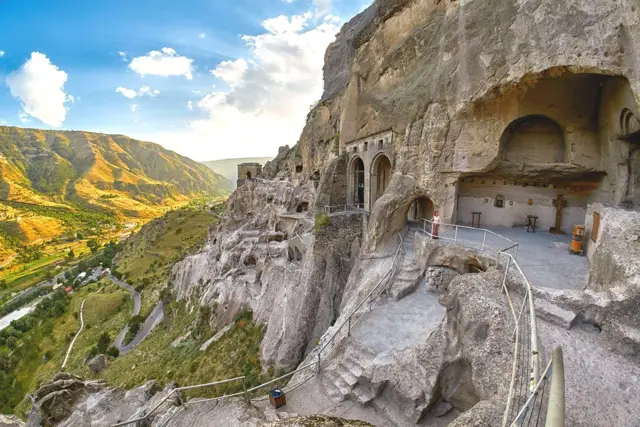
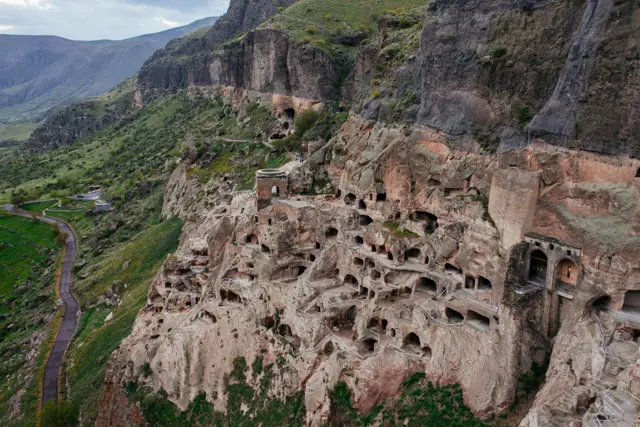
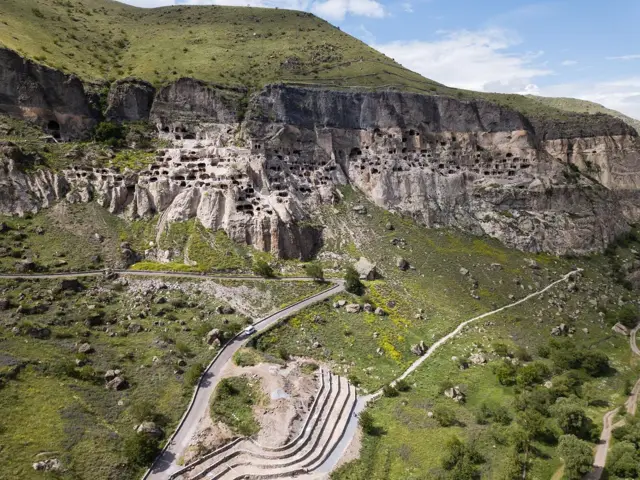
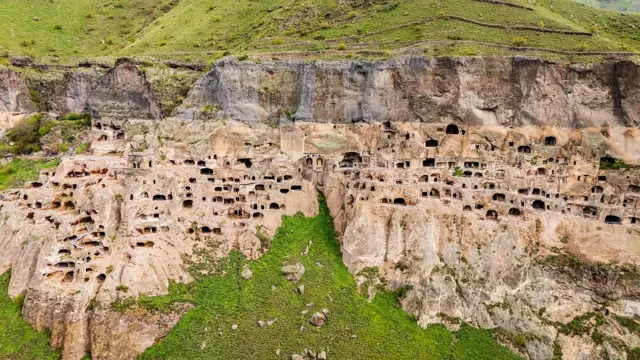
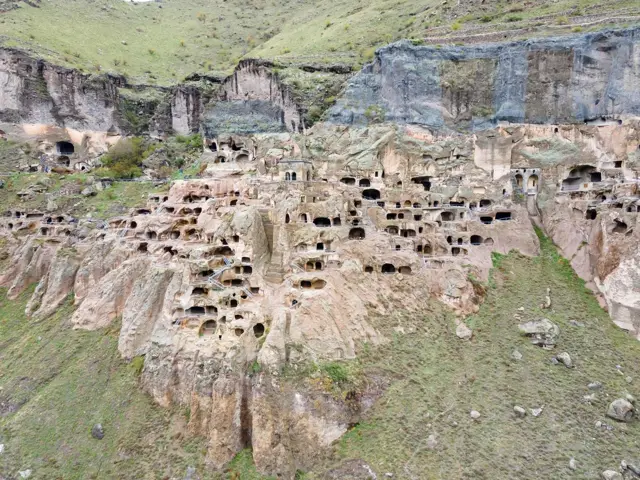
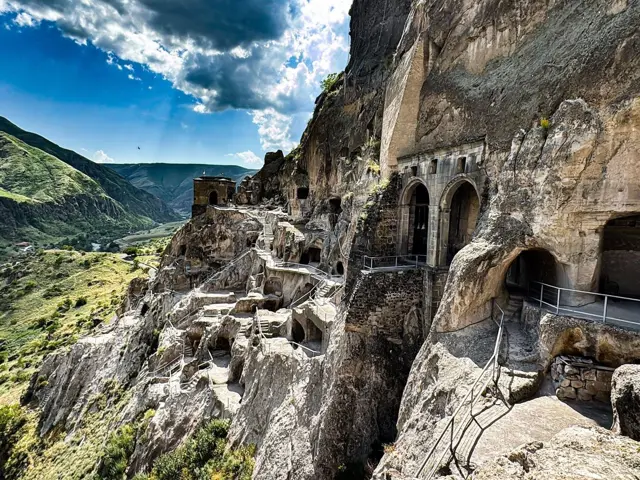
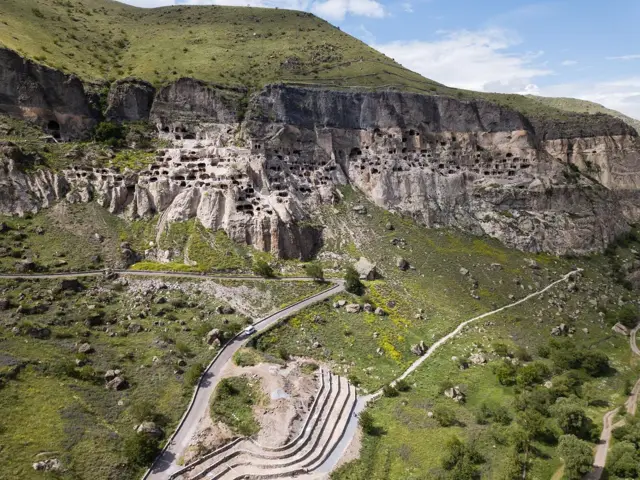
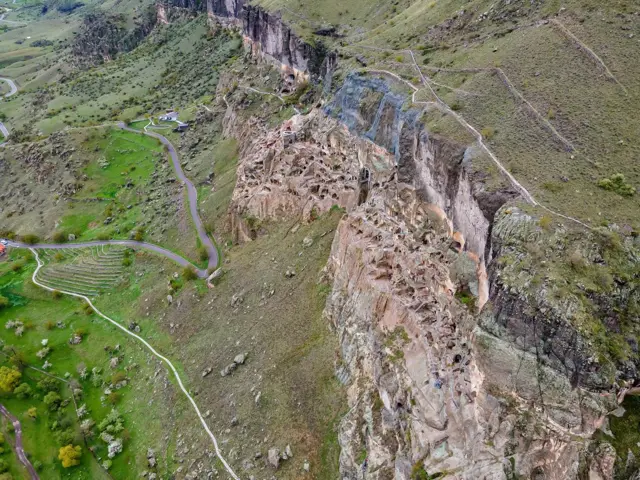
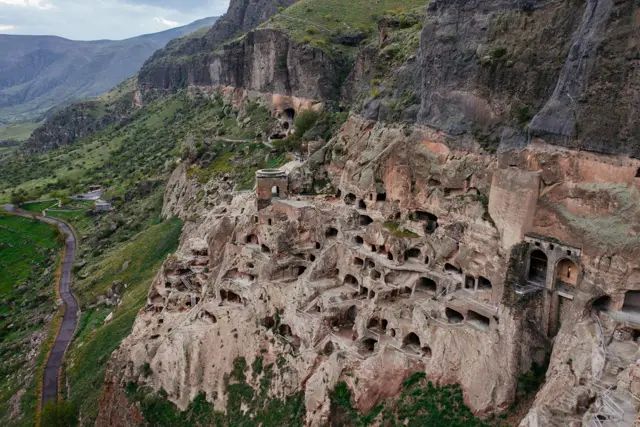
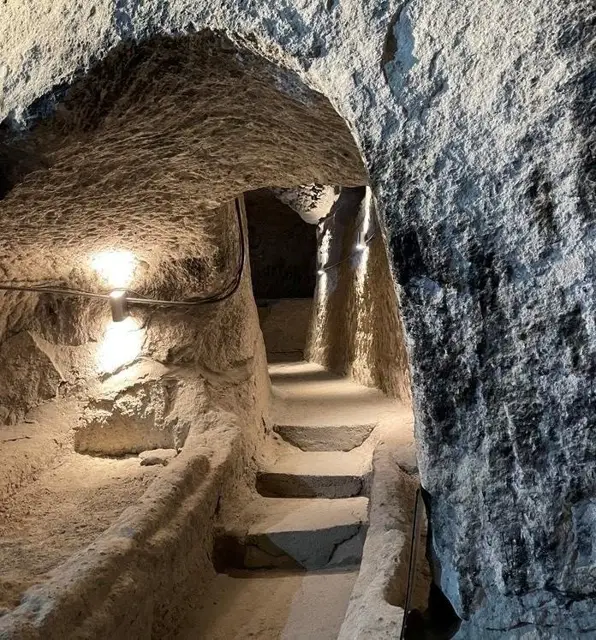
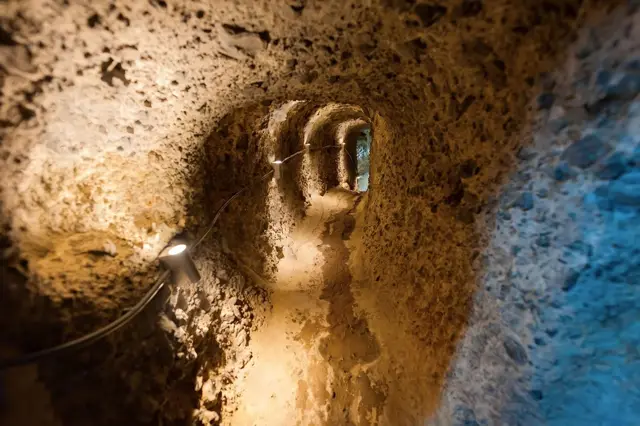
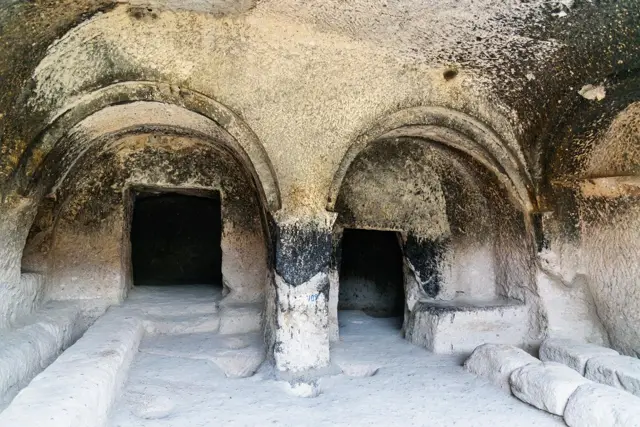
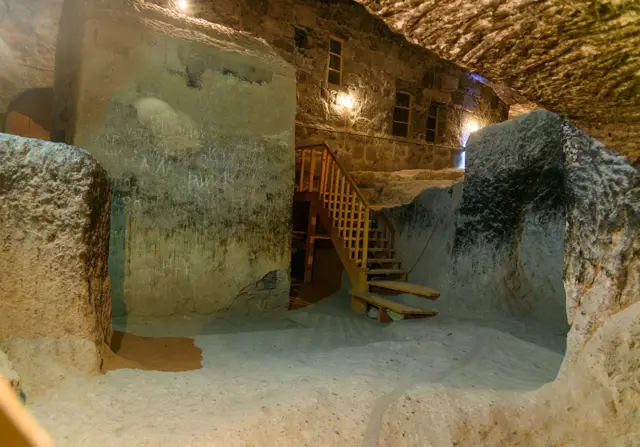
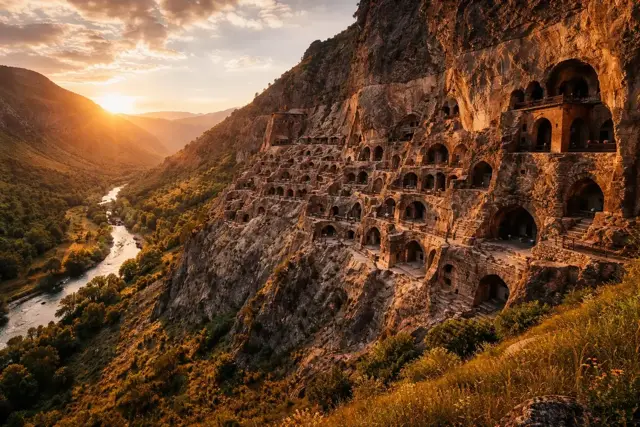
Architecturally, Vardzia resembles a true city carved into the rock. The complex was arranged on several levels and was originally much larger than it appears today. In the rock there were hundreds of rooms and spaces for various purposes, connected with one another by tunnels, passages and stairs.
Here there were monks' cells, churches, chapels, refectories, storerooms, wine cellars and work rooms. The spaces were arranged so that a large monastic community could live in the rock for a long time and organise its daily activity.
Vardzia's engineering system is especially impressive. The complex needed a constant water supply, so a complex system of water supply, channels and water storage spaces was created in the rock. In a dry rocky setting such a solution was essential to support the daily life of many monks and other inhabitants.
Vardzia's original appearance differed considerably from today's. A large part of the complex was hidden deep in the rock, and far less space was visible from outside. That is precisely why it was a naturally protected and hard-to-reach place.
One of the most tragic events in Vardzia's history was the strong earthquake of 1283. The disaster brought down a large part of the rock and destroyed many rooms and tunnels of the complex. It was as a result of this catastrophe that a large part of the rock face was opened up, and the multi-storey spaces that had until then been hidden deep in the mountain became visible from outside.
The earthquake caused great damage to the monastery, but monastic life did not stop. Some of the damaged parts were restored, and Vardzia remained an important spiritual centre. This clearly shows how great the monastery's importance was for medieval Georgia.
Vardzia's history is also closely linked with Georgia's military history. At the end of the 12th century, when the country was fighting powerful neighbours, Queen Tamar showed special honour to Vardzia. Georgian historical tradition also links Vardzia with the military successes of Tamar's age, especially the period when the defence of Georgia's southern borders was of special importance.
The monastery was at the same time a centre of learning and culture. Monks lived here who, besides praying, were occupied with copying manuscripts, church education and preserving cultural traditions. In such monasteries the intellectual environment was formed that became one of the foundations of Georgia's golden age.
Monastic asceticism held an important place in Vardzia's spiritual life. The small cells carved into the rock clearly show a way of life founded on prayer, fasting, humility and simplicity of daily life.
The difficult political situation of southern Georgia left a heavy mark on Vardzia too. From the 13th century Georgia faced Mongol invasions and political decline. Nevertheless, the monastery continued to exist and remained the most important centre of local Christian life.
Especially hard events took place in the 16th century. In this period southern Georgia became a battleground between Persia and the Ottoman Empire. Vardzia too fell victim to attacks and plunder, and later the establishment of Ottoman power in the region made the continuation of the old monastic life very difficult.
Nevertheless, Vardzia never disappeared from Georgian historical memory. The churches, tunnels, frescoes and monastic spaces left in the rock reminded people for centuries of one of the greatest eras of Georgia's strength.
In the 19th century, when the political situation of southern Georgia changed again, the interest of historians and travellers in Vardzia also grew. Gradually a more systematic study of the complex's architecture, frescoes and history began.
In the Soviet period Vardzia's religious function was restricted, though its importance as a unique historical and architectural monument was widely recognised. Archaeological and scholarly research was carried out, serving a better understanding of the complex's original structure and historical development.
After Georgia regained its independence, monastic life revived again at Vardzia. Today part of the complex is a functioning Orthodox monastery, and prayer and worship are still offered in its ancient spaces.
Vardzia's special importance lies precisely in the fact that it is not merely an archaeological monument. Some of the rock-cut rooms no longer exist and the scale of the old city has been much reduced, but the Church of the Dormition of the Mother of God and the monastic tradition are still alive.
Today whoever enters Vardzia gradually discovers the scale of the complex through intricate passages, stairs cut into the rock, cells and tunnels. Each space shows how the Georgian builders of the 12th century managed to turn natural rock into a complete world of dwelling, defence and the spirit.
Vardzia's position in the Mtkvari valley is especially impressive. The massive rock wall looks down on the river from above, while opposite it stretches the harsh mountain landscape of Meskheti. Architecture and nature are almost inseparable here.
Vardzia Monastery is a place where the history of Georgia's golden age comes alive with special force. The construction begun by Giorgi III, the grand expansion of Queen Tamar's age, the unique royal frescoes, hundreds of rock-cut spaces, the earthquake of 1283 and monastic life continued over the centuries form one great historical path.
Vardzia still remains today one of the greatest treasures of Georgia's spiritual, historical and architectural heritage: a world created in the rock, where the age of Queen Tamar, the Orthodox faith, Georgian art and the astonishing engineering ability of man still live in one space almost nine centuries later.