Jvari Monastery
The Mtkvari and the Aragvi were joined when a maiden raised a wooden cross and turned the desolate hill into a gate of heaven. That wood has long since turned to earth, but what Nino founded neither fire could burn nor time erase. To this day, at every dawn, the shadow of that first cross falls from the hill of Mtskheta over all Georgia.
- Region
- Mtskheta-Mtianeti
- UNESCO
- Yes
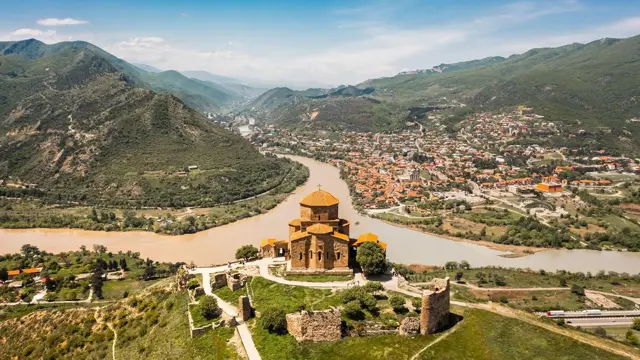
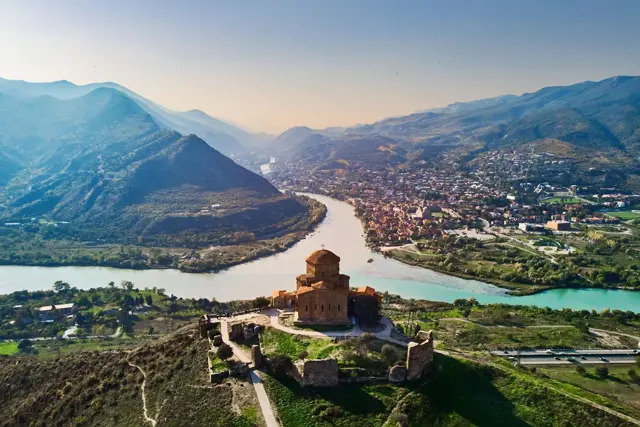
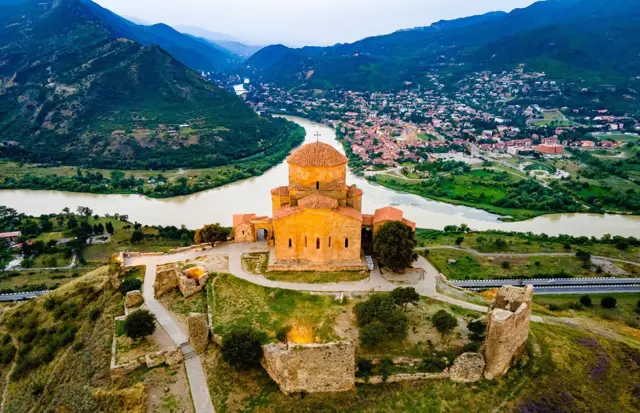
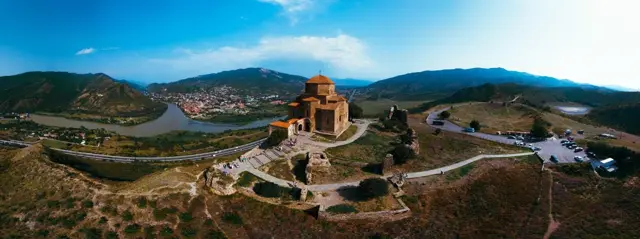
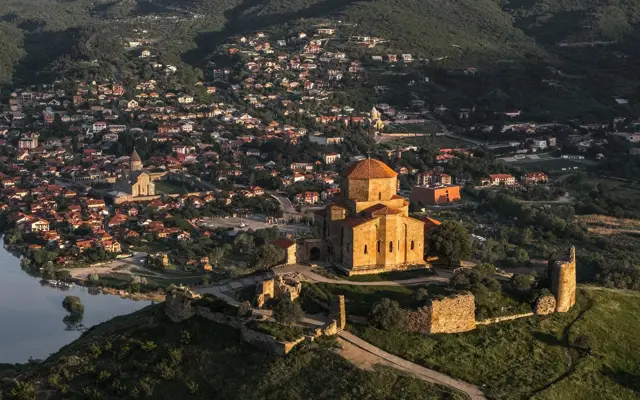
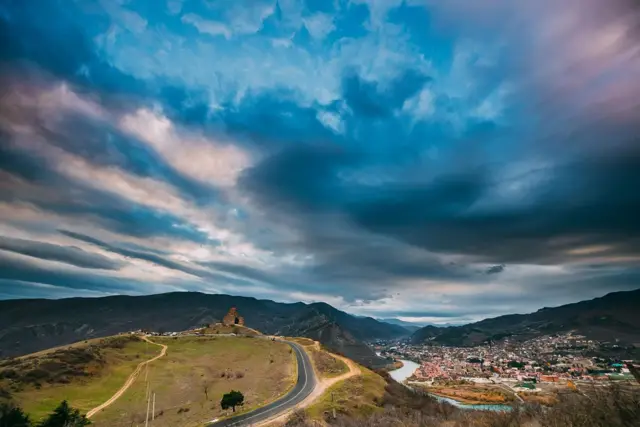
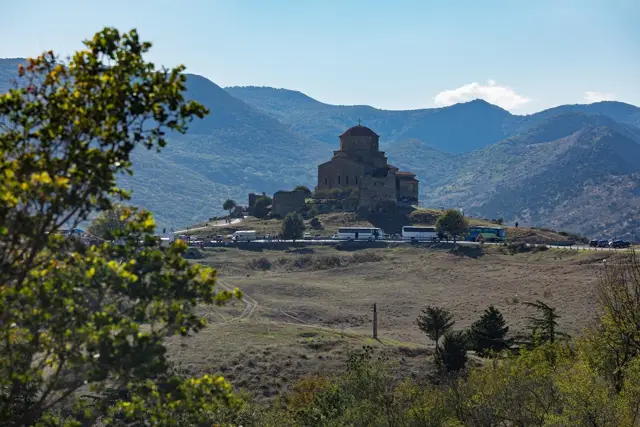
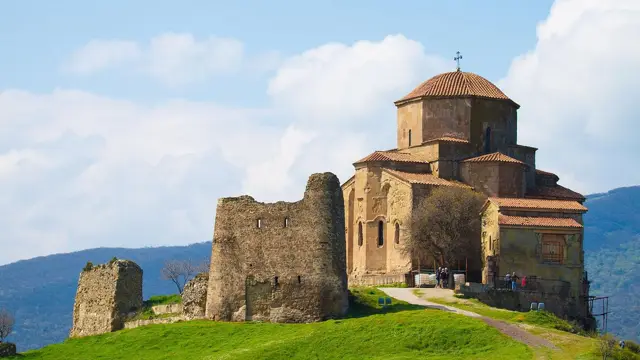
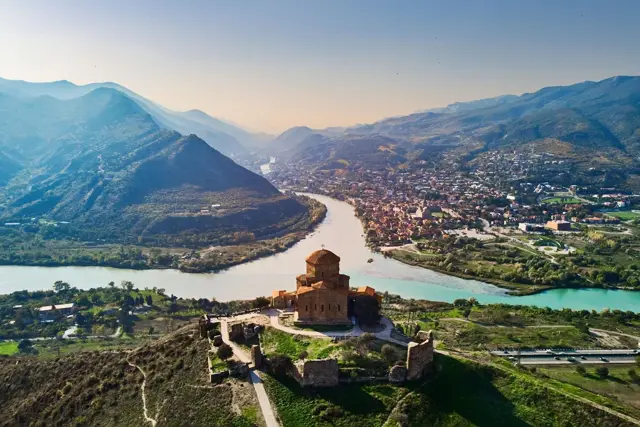
Jvari Monastery is one of the holiest and historically most important Christian sites in Georgia. It stands east of Mtskheta, on a high rocky hill from which there is a view over the ancient capital of Georgia and the confluence of the Mtkvari and the Aragvi. Yet Jvari's special significance lies not only in its architecture and its beautiful setting: this place is directly linked with Saint Nino, the conversion of Georgia and the establishment of the Christian faith in the 4th century.
The beginning of Jvari's history is linked precisely with the name of Saint Nino. Having come to Georgia from Cappadocia in the 4th century, Saint Nino preached Christianity in Kartli. The main centre of her work was Mtskheta, where at that time the royal power of Kartli and important sanctuaries of the pagan religion were concentrated.
According to Georgian Church tradition, Saint Nino's prayer and preaching led to the conversion of many people. Of special importance were the healing of Queen Nana and her conversion to Christianity. Later King Mirian III also accepted the Christian faith, and Georgian tradition links his conversion with a miraculous event.
According to tradition, during a hunt King Mirian suddenly found himself in darkness. He called on his old gods, but in vain. Then he called on the God of Saint Nino and the light returned. This event had an enormous influence on the king's decision. Mirian III accepted the Christian faith and in the 4th century supported the establishment of Christianity as the state religion of Kartli.
It was precisely in this period of great spiritual change that Saint Nino raised a large wooden cross on the hill above Mtskheta. The place was not chosen by chance. According to Church tradition, this hill had earlier been linked with pagan religious practice, and the raising of the Christian cross became a visible sign of the passage from the old religion to Christianity.
The cross raised by Saint Nino soon became an object of special veneration. Georgian traditions describe miracles and healings connected with it. Believers came from various places to pray at the cross, and so this hill became one of Georgia's first important Christian places of prayer.
It is from this cross that the name "Jvari", meaning "cross", comes. The present great church did not yet exist in Saint Nino's time. At first the main holy object was the raised wooden cross itself, and the church space around it developed later.
In the 6th century, as the importance of the holy place grew, a small church was built here, known today as the Small Jvari. Later, at the end of the 6th and the beginning of the 7th century, the present main church, the Great Jvari, was built beside it.
The Great Jvari was built approximately between 586 and 604 and is connected with the ruling prince of Kartli Stepanoz I and his family. The new church was planned so that the place connected with the holy cross would remain its central spiritual space. Thus the architecture of the 7th century was directly linked with the Christian tradition begun by Saint Nino in the 4th century.
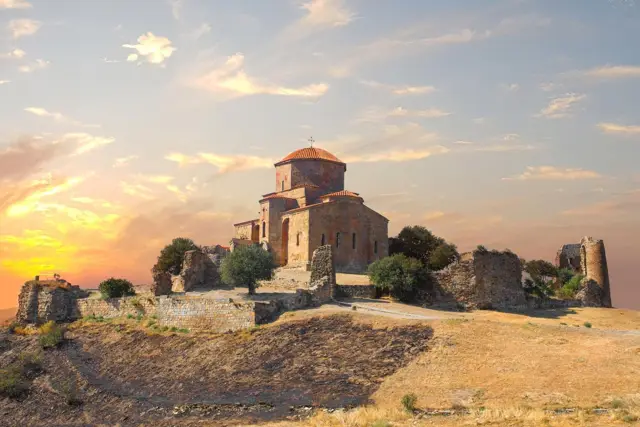
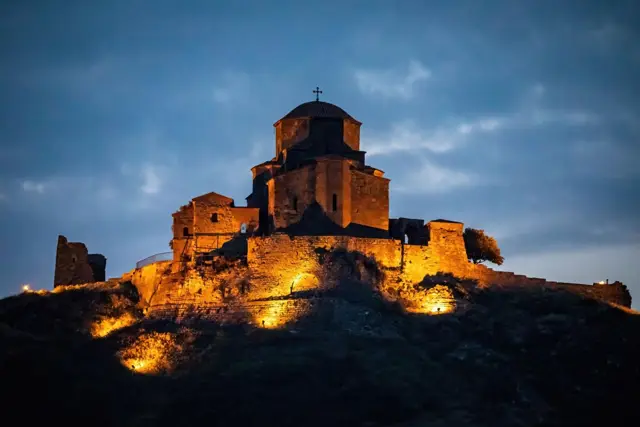
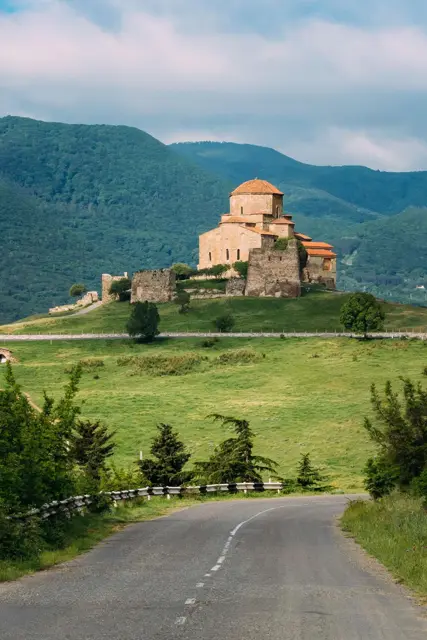
Architecturally, the Great Jvari is one of the most important masterpieces of early medieval Georgian architecture. It is a cross-domed building of the tetraconch type, with four apses arranged around the central space. Its architectural forms are clear, compact and exceptionally harmonious.
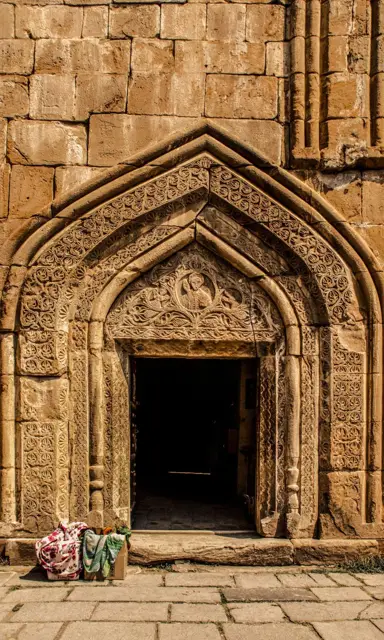
The exterior of the church is relatively austere, but the façades bear important stone reliefs and carvings. Particularly interesting are the relief images connected with historical figures and the Georgian inscriptions, which provide important information about the period when the church was built.
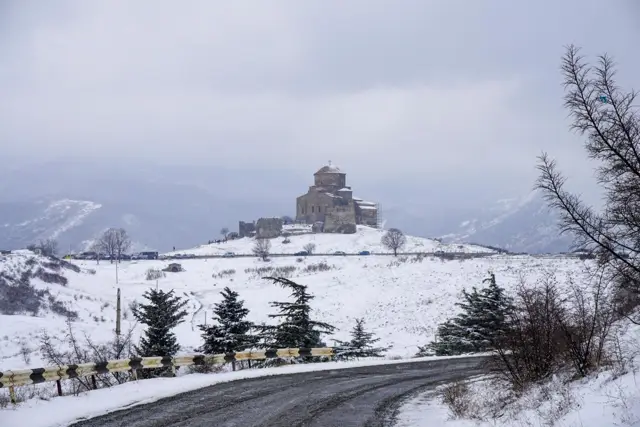
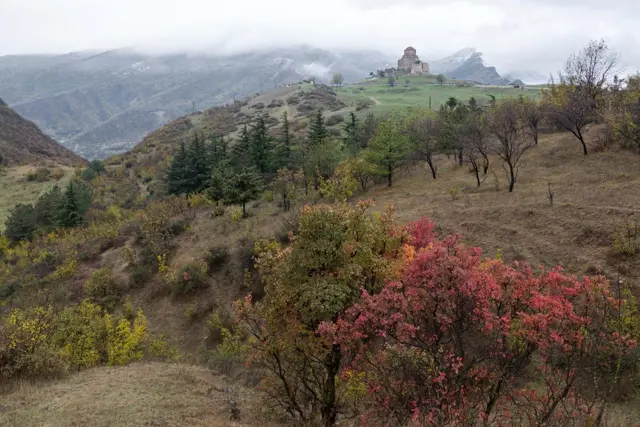
One of the chief merits of Jvari's architecture is its special unity with its surroundings. The church is set on top of the rock in such a way that it seems a natural continuation of the hill itself. Its proportions and silhouette can be clearly read even from afar, and all four sides of the building relate closely to the surrounding landscape.
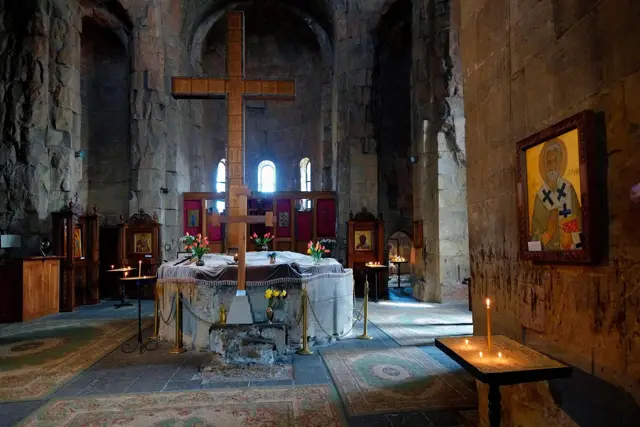
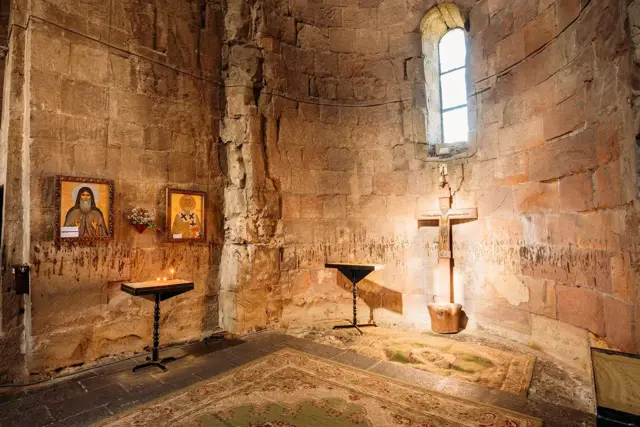
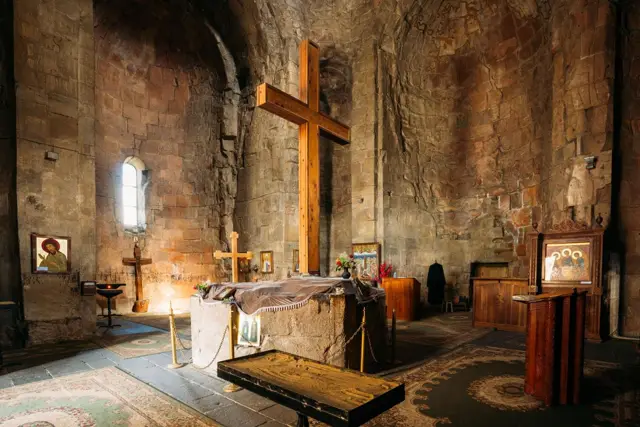
The interior of the church is far more modest. It lacks the rich fresco decoration found at Gelati and other later Georgian monasteries. The stone walls, the central domed space and the natural light create a special calm. It is precisely this architectural simplicity that strengthens the ancient spiritual character of the place.
From Jvari Monastery opens one of the best-known historical panoramas of Georgia: below lie Mtskheta, Svetitskhoveli and the confluence of the Mtkvari and the Aragvi. This view is especially symbolic, because in one space the two greatest sanctuaries of Georgia's Christian history can be seen: Jvari on the hill, and below, in Mtskheta, Svetitskhoveli.
The story of Saint Nino directly links these two places. In Mtskheta, with her preaching and the conversion of King Mirian and Queen Nana, a new Christian era began; on the site of Svetitskhoveli the first church was built, and on the hill above Mtskheta Saint Nino's cross became the symbol of the victory of the Christian faith.
Over the centuries Jvari Monastery remained one of the most important places of prayer in Georgia. Kings, clergy, monks and ordinary believers came here. Despite political conflicts and the invasions of foreign powers, the church has preserved its early architectural form remarkably well.
In the 19th century, after Georgia's incorporation into the Russian Empire, the situation of the Georgian Church changed considerably. Even harder was the Soviet period, when religious life was severely restricted. Nevertheless, Jvari survived and remained in the historical memory of the Georgians one of the main symbols of the conversion of Georgia.
After Georgia regained its independence, the church life of the monastery revived. Today Jvari Monastery is a functioning Orthodox sanctuary, where services are held and where Georgian and foreign pilgrims come every day.
In 1994 Jvari Monastery, together with Svetitskhoveli and other historical monuments of Mtskheta, was inscribed on the UNESCO World Heritage List. Its importance is also recognised internationally as an outstanding example of early medieval Georgian Christian architecture.
Yet the main significance of Jvari Monastery is not defined by its architecture alone. At the centre of its history stand Saint Nino and the cross she raised. It was precisely here that the Christian cross became the symbol of the great spiritual transformation which in the 4th century determined the later history of Georgia.
Jvari Monastery is the place where the history of Georgia's conversion, the work of Saint Nino, early Georgian architecture and the holy landscape of Mtskheta come together as one whole. Almost seventeen centuries later the hill still looks down on Mtskheta, and the church guards the place where, according to Georgian Church tradition, Saint Nino raised the cross as a sign of the victory of the Christian faith.
Jvari remains today one of the greatest symbols of Georgia's spiritual roots: a place that reminds the Georgian people of Saint Nino, of the conversion of the country and of the beginning of the Christian path which over the centuries shaped Georgia's faith, culture and national identity.