Alaverdi Monastery
On the soil of Kakheti, in the silence of the centuries, the cathedral of Alaverdi soars to the height of the sky, keeper of faith, learning and the memory of kings. Here prayer and history are heard as one voice.
- Region
- Kakheti
- UNESCO
- No
Alaverdi Monastery is one of the oldest and most important spiritual centres of Georgia. It stands in Kakheti, in the Alazani valley, against the background of the Caucasus mountains, and for centuries it was one of the main pillars of Christian life in eastern Georgia. The history of Alaverdi spans almost fifteen centuries and brings together the Thirteen Assyrian Fathers, Saint Joseph of Alaverdi, the kingdom of Kakheti, Georgian monasticism and the country's centuries-long struggle to preserve its faith.
The history of Alaverdi begins in the 6th century, when the Thirteen Assyrian Fathers were at work in Georgia. Their aim was to strengthen the Christian faith in the country and to develop monastic life. One of these fathers was Saint Joseph of Alaverdi, who chose Kakheti as the place of his labours.
Saint Joseph was at first connected with his spiritual teacher, Saint John of Zedazeni. Later, like the other Assyrian Fathers, he left Zedazeni and set out for different parts of Georgia to spread Christian preaching and ascetic life. Saint Joseph settled in the Alazani valley, where he lived in solitude, prayed and preached Christianity to the local people.
According to Church tradition, he built a small church in the name of Saint George at this place. It was around this little shrine that monastic life began to take shape. In time disciples gathered around Saint Joseph, and Alaverdi became one of the important Christian centres of Kakheti.
Saint Joseph of Alaverdi laboured here until the end of his life. After his death he was buried in the church he himself had founded. The saint's tomb remains to this day one of the chief holy places of Alaverdi, and the monastery's special spiritual significance is connected above all with his name.
A new great stage in the history of Alaverdi began at the start of the 11th century. In this period Kakheti was experiencing a significant political and cultural rise. King Kvirike III the Great of Kakheti began building a grand cathedral on the site of Saint Joseph's old church. Created around the first half of the 11th century, this building is still the main church of Alaverdi Monastery today.
The new cathedral was again consecrated in the name of Saint George and in its scale was completely different from the small 6th-century church. Its construction expressed the growing importance of Alaverdi: the small monastery founded by Saint Joseph became one of the main church centres of Kakheti.
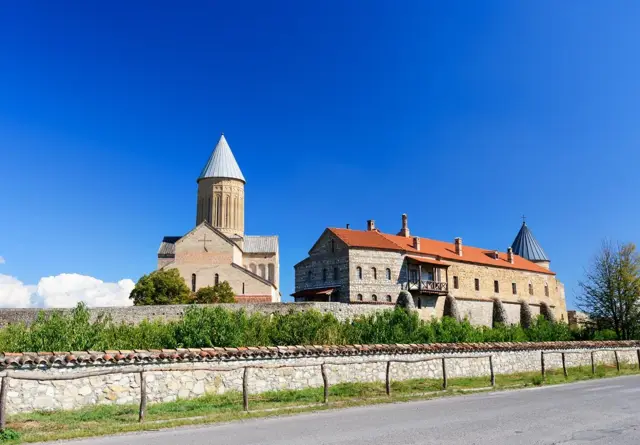
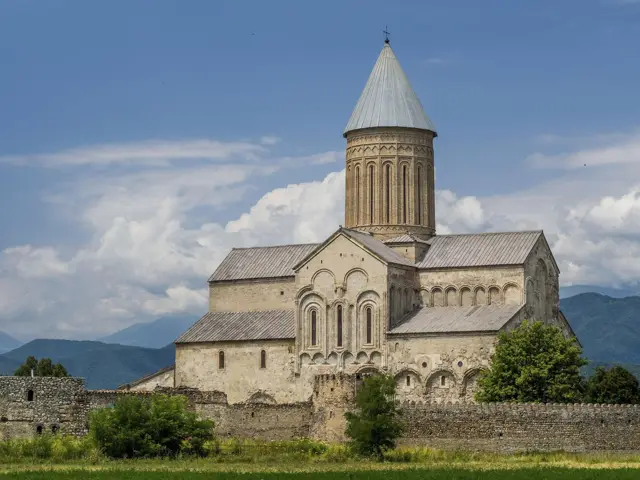
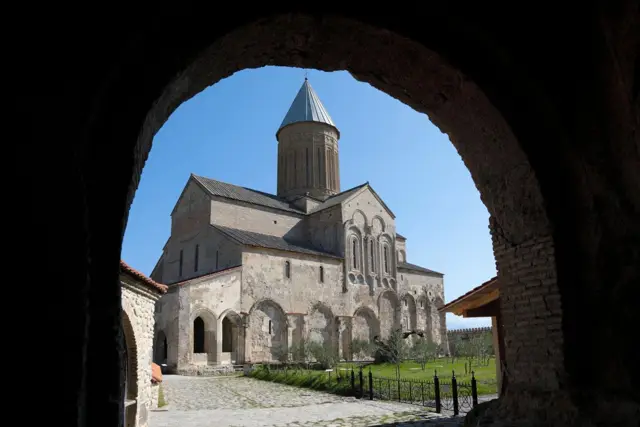
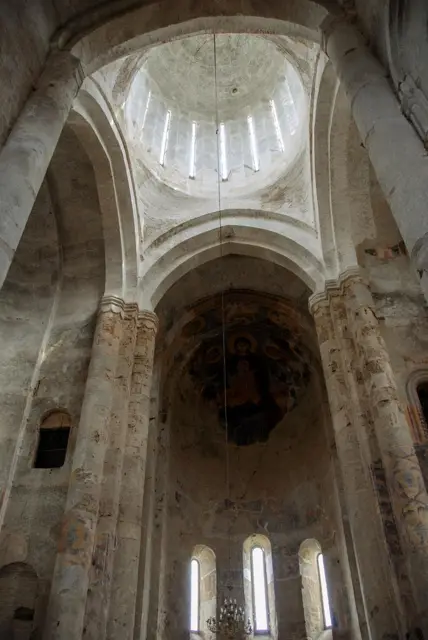
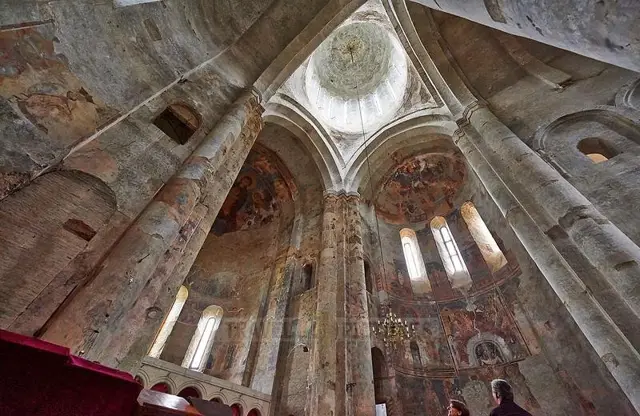
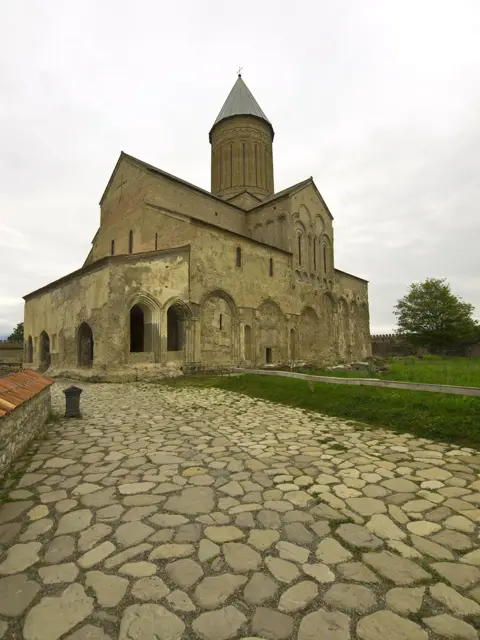
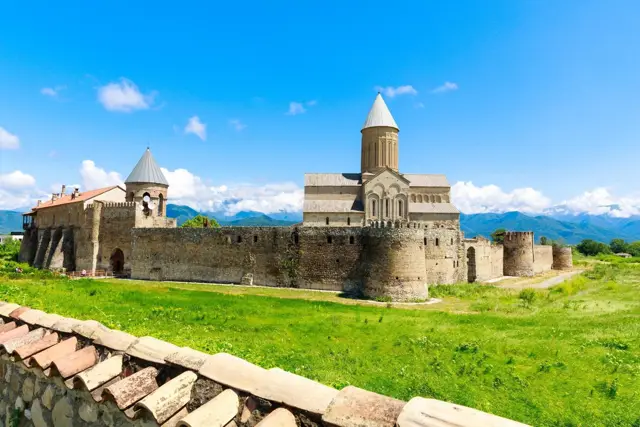
Architecturally, Alaverdi Cathedral is one of the outstanding examples of monumental Georgian medieval church architecture. The high dome, vertically developed proportions and enormous interior space give the cathedral special grandeur. For centuries it was considered one of the tallest church buildings in Georgia.
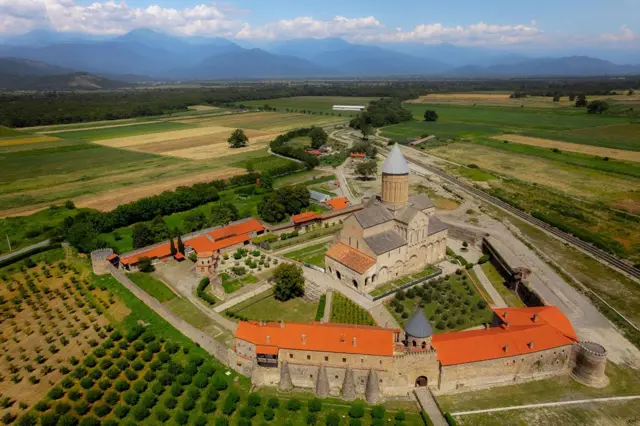
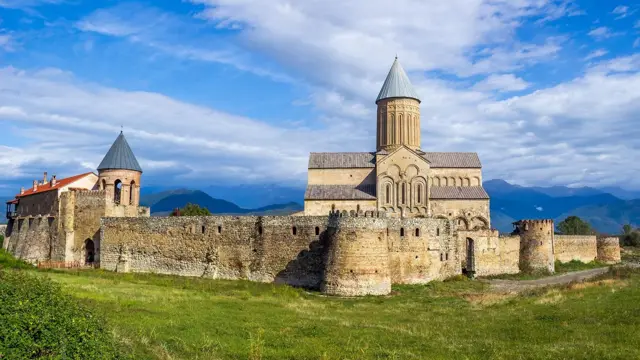
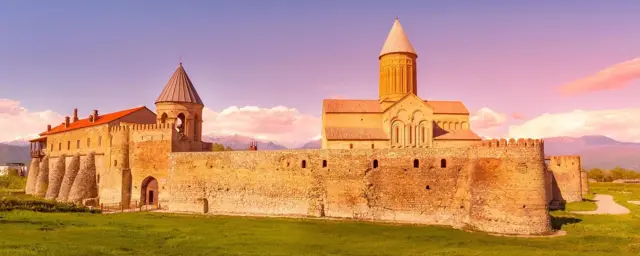
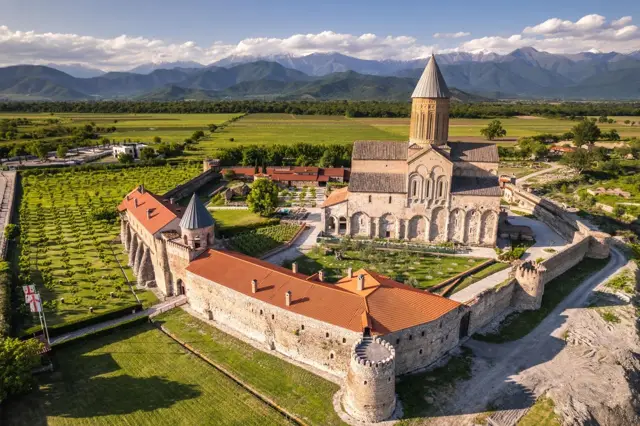
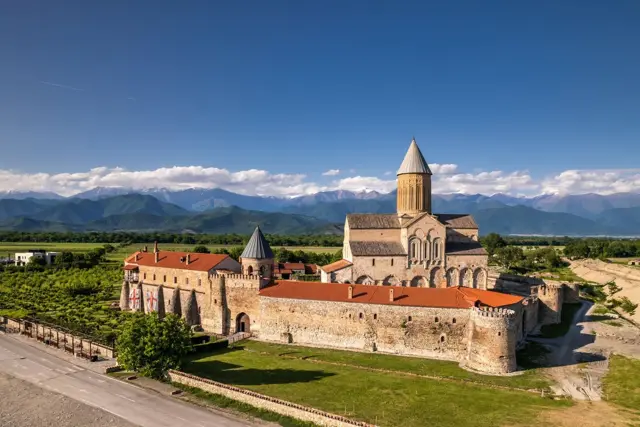
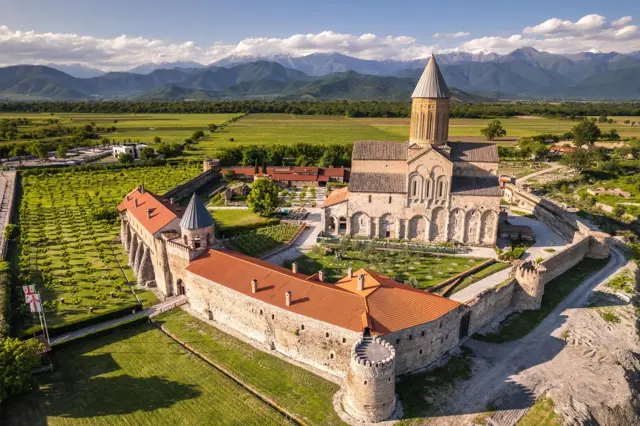
The cathedral looks especially impressive in the broad, almost flat landscape of the Alazani valley. Its high dome can be seen from afar, and the Greater Caucasus mountains rising behind it make Alaverdi's architectural image even more monumental. It is this unity of cathedral and natural setting that creates one of the best-known historical panoramas in Georgia.
The façades of Alaverdi are relatively austere and restrained. The monumental stone walls, arched elements and the tall drum of the dome create the harmonious whole characteristic of Georgian medieval architecture. The cathedral's grandeur lies not in excessive decoration, but in its scale, its proportions and the solidity of its forms.
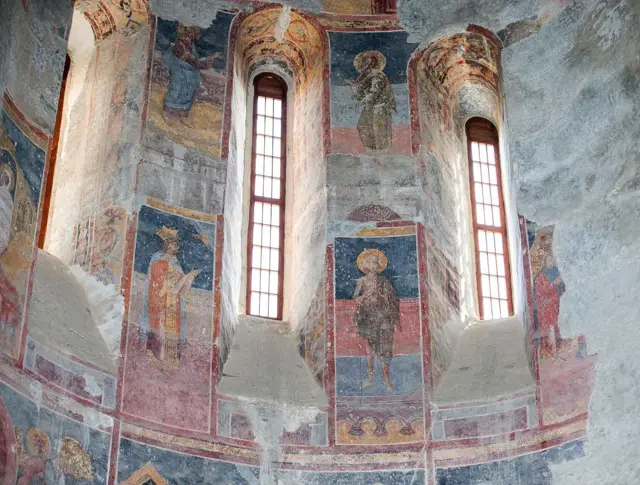
Traces of fresco painting from different periods survive in the cathedral's interior. Over the centuries the walls were painted and renewed more than once. Wars, earthquakes and later restorations damaged a large part of the original painting, but the surviving fragments still preserve the centuries-long history of Georgian church art.
Alaverdi was not only a church. Over the centuries a large monastic complex formed around it, including a defensive wall, living quarters and farm buildings, a wine cellar and other spaces. Because of Kakheti's historically difficult situation, the defence of the monastery was of special importance.
Alaverdi was also an important educational and cultural centre. Clergy and scribes worked here, manuscripts were created and kept, church books were copied and Georgian monastic culture developed. Thus for centuries the monastery was not only a place of faith but also a place where Georgian written culture was protected.
The history of Alaverdi is especially closely linked with the royal dynasty of Kakheti. The cathedral also became an important royal burial place, and the memory of many well-known figures of Georgian history is kept here. Particularly connected with Alaverdi is King Teimuraz I of Kakheti, a poet, whose life coincided with one of the hardest periods of 17th-century Georgia.
The story of the holy great martyr Queen Ketevan is also connected with this period. In 1624 in Shiraz she was cruelly tortured for refusing to deny the Christian faith. Part of her holy relics later returned to Georgia and, according to Church tradition, is also linked with Alaverdi. That is why the memory of Queen Ketevan holds a special place in the spiritual history of the monastery.
Over the centuries Alaverdi Monastery repeatedly found itself at the centre of enemy invasions and political conflicts. Kakheti suffered especially often from invasions by Persian forces. The cathedral and other monastery buildings were damaged in different periods, but through the efforts of Georgian kings and clergy they were restored again.
Nor was Alaverdi spared by natural disasters. Strong earthquakes threatened the cathedral more than once, and certain parts of its architecture had to be restored. Despite repeated damage and alterations, the monastery kept its main architectural form and spiritual significance.
Another interesting part of Alaverdi's culture is the monastic tradition of viticulture and winemaking. Kakheti is the main region of ancient Georgian winemaking, and for centuries the monastery too had its own wine cellar. Wine has special significance in the Christian liturgy, so here the culture of the vine and monastic life naturally became linked.
Closely connected with Alaverdi is the feast of Alaverdoba, one of the oldest church and folk festivals in Georgia. It is linked with the memory of Saint Joseph of Alaverdi and every year brings together large numbers of faithful and pilgrims at the monastery. Over the centuries Alaverdoba has become an important event in the spiritual and social life of Kakheti.
In the Soviet period monastic life was severely restricted, and Alaverdi shared the fate of many other holy places in Georgia. Nevertheless, the cathedral survived and did not lose its historical and cultural significance. After Georgia regained its independence, monastic and church life revived here once more.
Today Alaverdi Monastery is a functioning Orthodox monastery and one of the main spiritual centres of Kakheti. Here the faithful especially honour Saint Joseph of Alaverdi and the centuries-old Christian tradition that has been linked with this place without interruption since the 6th century.
Alaverdi Monastery is the place where the spiritual heritage of the Thirteen Assyrian Fathers, the work of Saint Joseph of Alaverdi, the history of the kingdom of Kakheti, medieval Georgian architecture, Christian art and ancient monastic tradition meet. From the small 6th-century church to the grand 11th-century cathedral, from invasions and earthquakes to today's living monastery, Alaverdi has kept its spiritual mission for almost fifteen centuries.
Alaverdi remains today one of the greatest symbols of Georgian faith, of the history of Kakheti and of the nation's spiritual heritage: the monastery begun by Saint Joseph of Alaverdi which, centuries later, continues to guard Georgia's Christian tradition.