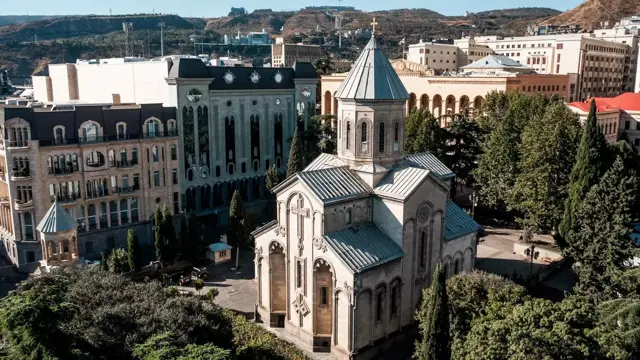
Kashveti Church of Saint George
The stone that once bore witness to the truth has kept, in its name, a prayer for the city. On Rustaveli Avenue day and night follow one another and people hurry by, but the door of Kashveti is always open to those who need to stop. Here candlelight touches history: the silence of David of Gareja, the colours of Gudiashvili, and also the pain that fell upon this avenue one April night. Tbilisi changes, yet Kashveti keeps what never grows old: a person's wish to be alone with God.
- Region
- Tbilisi
- UNESCO
- No
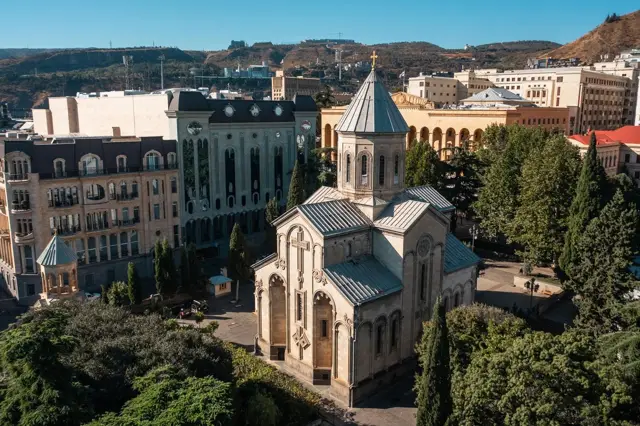
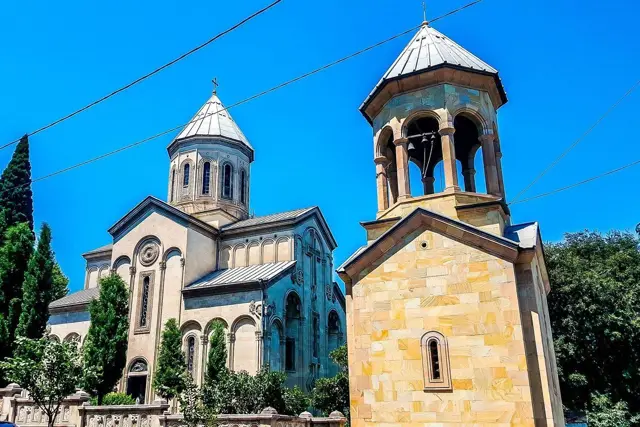
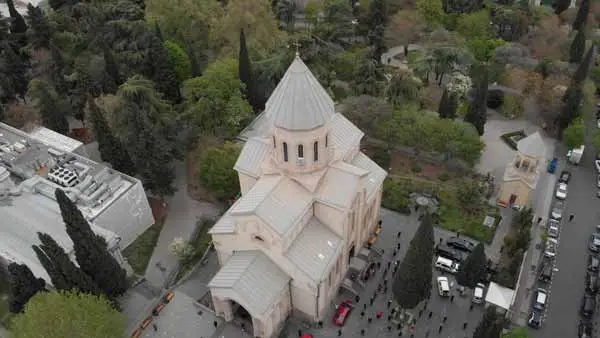
The Church of Saint George of Kashveti is one of the best-known Orthodox churches in Tbilisi. It stands in the heart of the capital, on Rustaveli Avenue, near the building of the Parliament of Georgia. Raised in one of the busiest and most historic spaces of the city, this white stone church today blends naturally into the cultural and social life of Tbilisi, although the church history of this place is many centuries older than the present building.
The beginning of Kashveti's history is traditionally linked with the 6th century and the name of Saint David of Gareja. David of Gareja was one of the Thirteen Assyrian Fathers who came to Georgia to strengthen the Christian faith. Before settling in the Gareja wilderness and founding there one of the most important Georgian monastic centres, according to tradition he laboured for some time in Tbilisi.
Georgian church and oral tradition connects the name of David of Gareja with the site of Kashveti through a special story. According to tradition, a woman slandered the holy father and declared that she was pregnant by him. David entrusted his innocence to God and said that if the accusation was true the woman would give birth to a child, and if it was false, to a stone.
According to tradition, the woman did indeed give birth to a stone. Tradition links the origin of the name with precisely this story: "kva shva", "she bore a stone", from which the names Kvashveti, Kashueti and Kashveti developed over time.
This story is a church tradition and not an event documented by modern historiography. Yet over the centuries it became so closely bound up with this place that it turned into an inseparable part of Kashveti's name and spiritual identity.
What is more reliably established about Saint David of Gareja is that he laboured in Georgia in the 6th century and then settled with his disciple Lucian in the rocky wilderness of Gareja. The monastic work he began there later became the foundation of the vast monastic world of David Gareja. Georgian encyclopaedic sources also note that oral tradition links David's name both with Mamadaviti and with the site of Kashveti.
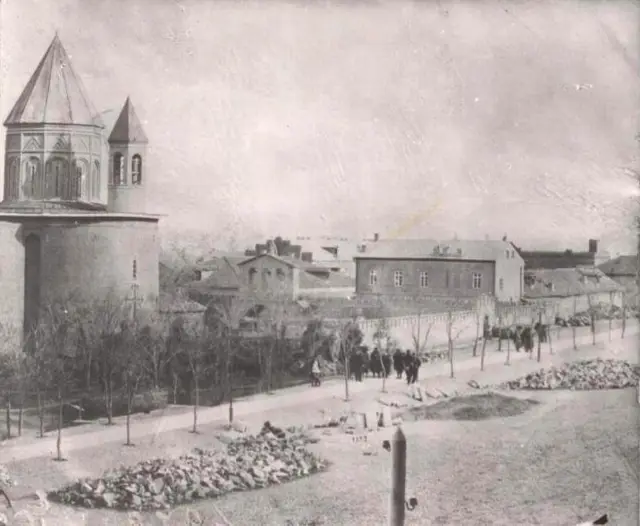
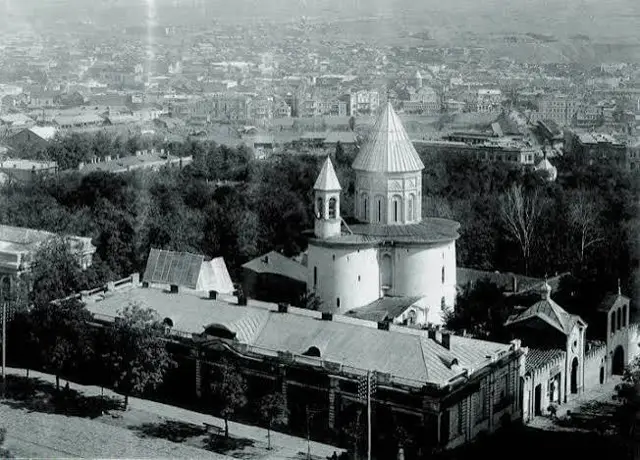
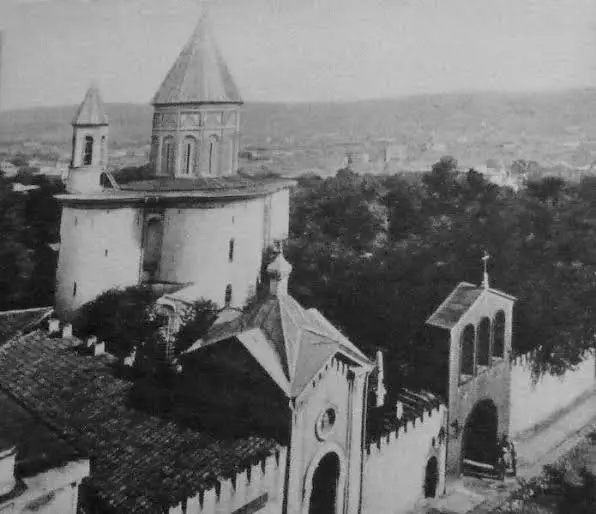
At Kashveti churches succeeded one another over the centuries. According to tradition, a Christian place of worship existed here as early as the time of David of Gareja, although the present church is, of course, not a building of that period.
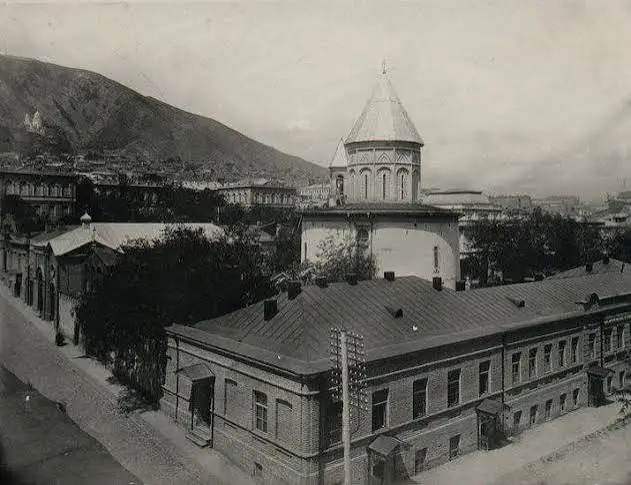
An important stage in the history of Kashveti belongs to the 18th century. On the site of the old church the Georgian prince Givi Amilakhvari built a new one. The building inscription preserved in the church connects this construction with the year 1753. The Amilakhvari family remained closely linked with the history of Kashveti afterwards as well.
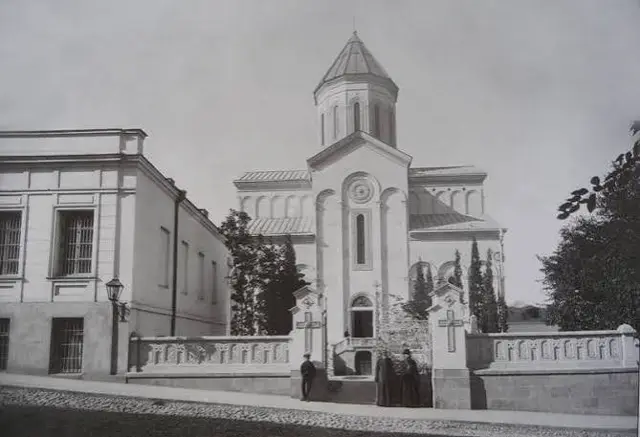
By the end of the 19th century the old church could no longer meet the needs of fast-growing Tbilisi. The city was expanding, and the area around Rustaveli Avenue was gradually becoming one of the main social and cultural centres of Tbilisi. It became necessary to build a larger and more representative church.
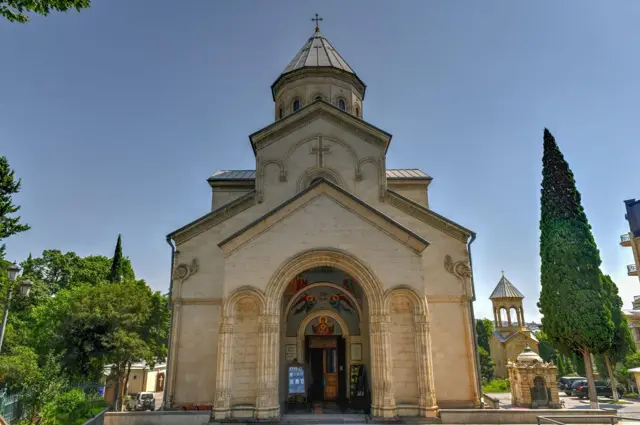
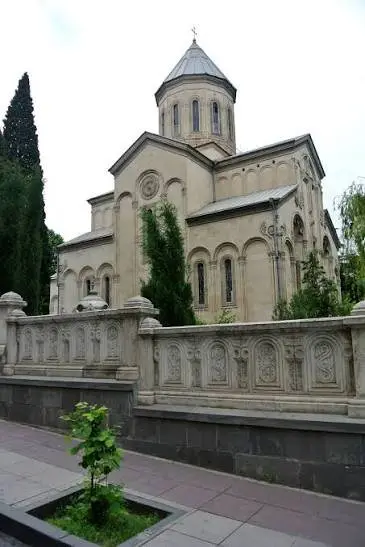
Construction of the present Church of Saint George of Kashveti began on 12 November 1904. The main author of the design was the German-born architect Leopold Bielfeld, and the architect E. Andreoletti and Georgian stonemasons were involved in the work.
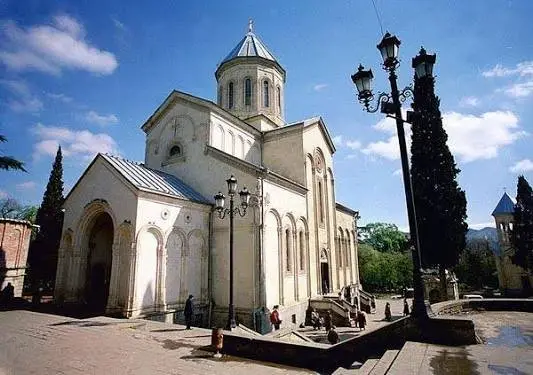
The architectural model of the new church was not chosen by chance. It was based on one of the most outstanding monuments of medieval Georgian architecture: the 11th-century cathedral of Samtavisi.
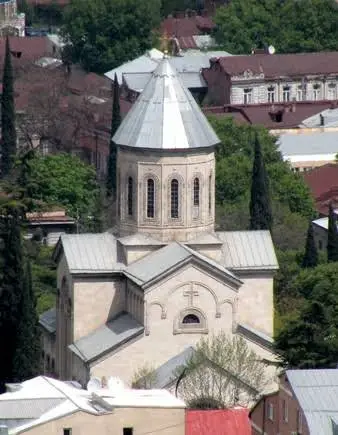
Kashveti is not a direct copy of Samtavisi. The architect reworked its composition to suit the new site, the age and functional requirements. The result was a cross-domed, three-nave church that has the character of medieval Georgian church architecture but is a new building of the early 20th century.
The church's exterior stone decoration is especially impressive. The ornaments and carvings on the façades continue the medieval Georgian tradition of stone carving. Georgian stonemasons played a great part in carrying out the decorative work, among them the Agladze family.
Various members of Georgian society of the time took part in building the church and gave financial help. Among the donors the well-known Georgian businessman and patron David Sarajishvili is also named.
After several years of construction, the church was completed and consecrated in 1910. From that time the new Kashveti on Rustaveli Avenue became one of the most outstanding church buildings in Tbilisi.
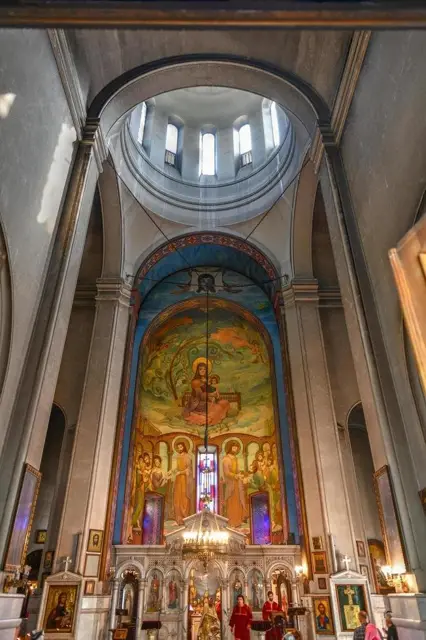
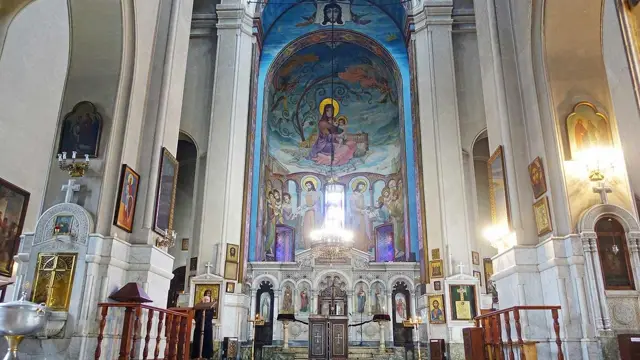
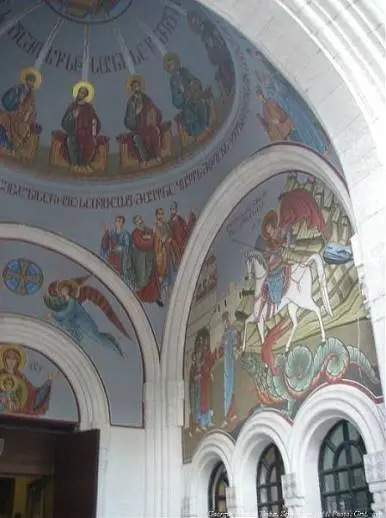
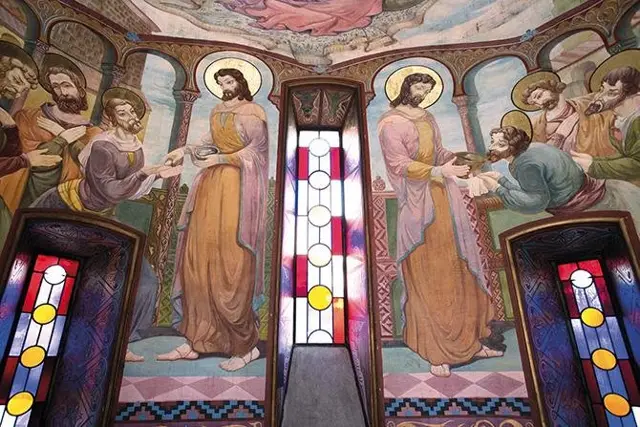
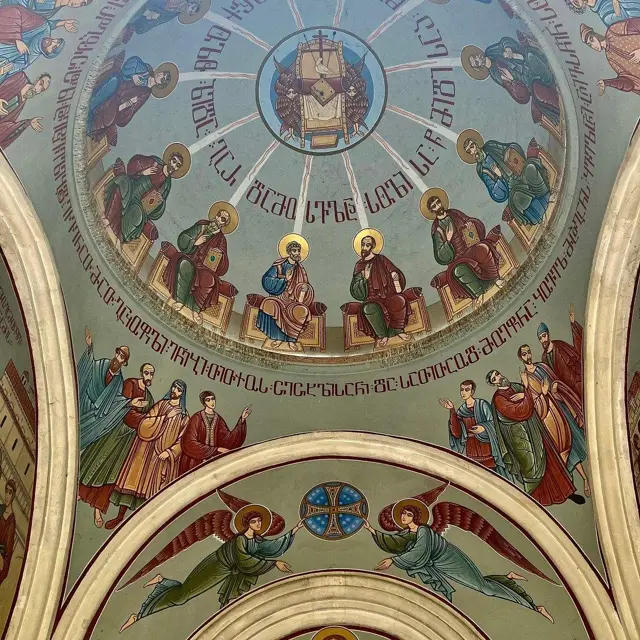
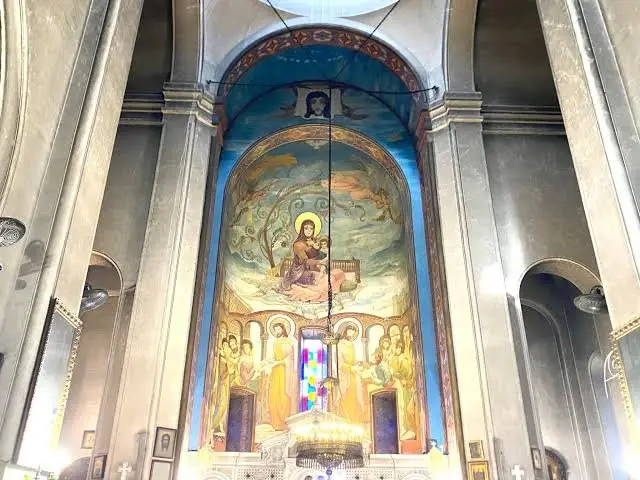
The works of the great 20th-century Georgian painter Lado Gudiashvili give special significance to the interior of Kashveti. In 1946–1948 Gudiashvili painted the sanctuary of the church.
This was especially significant in the conditions of the Soviet era. In those years religious life was severely restricted, most churches were closed and the creation of new works of Christian art was a rare event. It was in precisely such an environment that Gudiashvili created the compositions of Kashveti's sanctuary.
His painting differs sharply from ordinary academic church painting. Gudiashvili's characteristic colour system, the expressiveness of the faces and his special attachment to the Georgian artistic tradition give the interior of Kashveti a unique character.
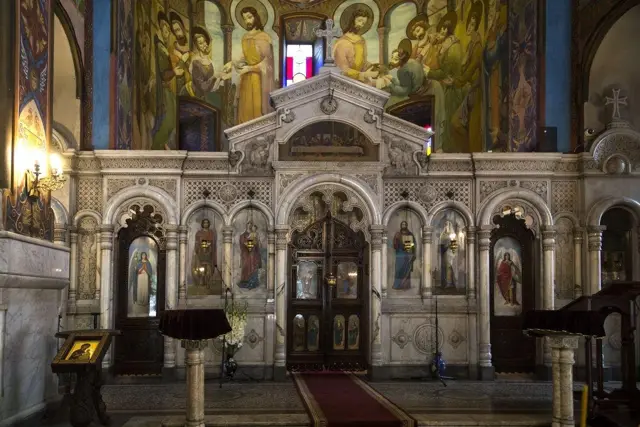
The church has another interesting architectural peculiarity. Its iconostasis is not placed in the traditional position but is set further back, so as to leave more room for worshippers in the main space of the church. This solution gives the layout of Kashveti a certain distinctiveness compared with other Georgian churches.
Throughout the 20th century Kashveti found itself in the immediate vicinity of Tbilisi's most important events. In front of it and around it the public life of the country unfolded, especially at the end of the Soviet period and in the years when the Georgian national movement grew stronger.
Rustaveli Avenue beside the church is also linked with one of the most tragic events in Georgia's recent history: 9 April 1989, when the Soviet army violently dispersed a peaceful demonstration gathered outside the Parliament building. Kashveti also became part of the spiritual memory of this place, and every year prayer is offered here too in memory of the victims of the tragedy.
Today the Church of Saint George of Kashveti is a functioning Orthodox church. In the city centre, in the midst of noisy Rustaveli Avenue, the Divine Liturgy is still celebrated within its walls, candles are lit and every day people come in to pray.
Kashveti's distinctiveness lies precisely in the fact that very different eras of Georgian history are bound together in one place: David of Gareja in the 6th century, the Amilakhvaris in the 18th century, the Georgian architectural revival of the early 20th century, the art of Lado Gudiashvili, the Soviet period and the national memory of modern Georgia.
The Church of Saint George of Kashveti is not only a beautiful church on Rustaveli Avenue. In its name the ancient tradition connected with David of Gareja lives on to this day; in its stones, the centuries-old tradition of Georgian architecture; in its sanctuary, the art of Lado Gudiashvili; and around it, the memory of the most important events of Tbilisi's recent history.
Centuries changed, Tbilisi grew and an entirely new city took shape around it, but the site of Kashveti kept its spiritual significance. Today too the Church of Saint George, rising amid the noise of Rustaveli Avenue, remains a place where Georgia's history, art and Orthodox faith go on living in one space.