Church of Saints Cyricus and Julitta (Lagurka)
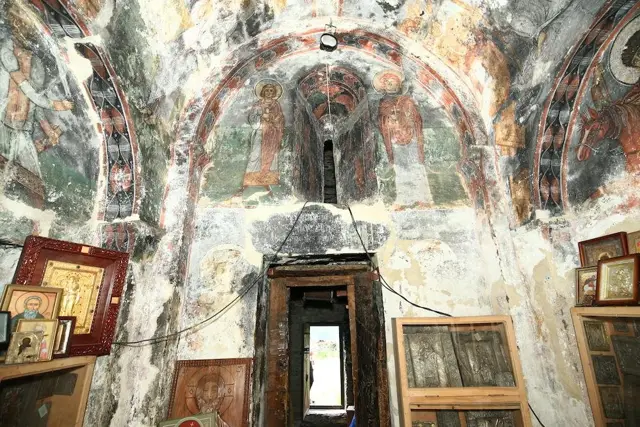
The light that enters through the narrow window touches the painting of Tevdore, which for more than nine centuries has silently kept the face of Christ and of the Mother of God. The stones of Kala bear witness to a faith that never faded: it only sank deeper into the silence of the mountain.
- Region
- Svaneti
- UNESCO
- No
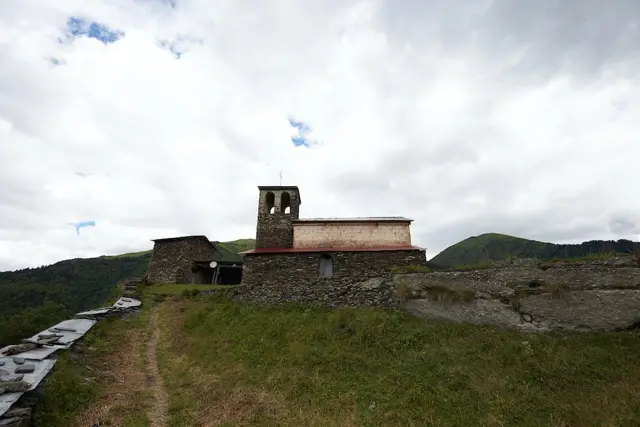
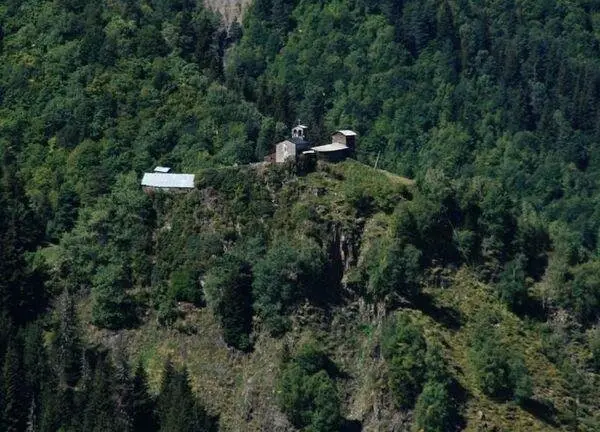
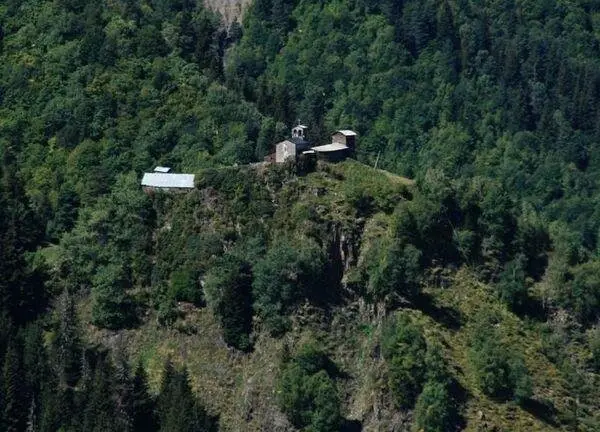
The Church of Saints Cyricus and Julitta, which in Svaneti is called Lagurka, is one of the holiest and historically most important Christian sanctuaries of Upper Svaneti. It stands in the Mestia municipality, in the Kala community, on a high slope rising above the Enguri valley. Surrounded by the mountains of the Caucasus, this small stone church was for centuries not only a place of prayer but a special place of the Svans' spiritual unity, of oaths and of community memory.
Lagurka is dedicated to early Christian martyrs: Saint Cyricus and his mother, Saint Julitta. Their martyrdom belongs to the period of persecution of Christians, the age of the emperor Diocletian. According to church tradition, Julitta was a Christian woman who raised her little son Cyricus in the Christian faith.
When the persecution of Christians grew stronger, Julitta was forced to leave her home with her son. In the end they were arrested in Tarsus. Julitta was ordered to deny Christ, but she did not give up her faith. According to church tradition, the little Cyricus too showed loyalty to his mother's faith, and both died as martyrs. Their memory became in the Orthodox Church a special example of a mother's and son's faithfulness to Christ.
In Svaneti the veneration of Saints Cyricus and Julitta became especially strong. In time Lagurka became one of the chief places of prayer of the Kala community and of all Upper Svaneti. Its importance was not limited to a single village: people came here from various Svan communities to pray, to ask for the saints' help and to celebrate major religious feasts.
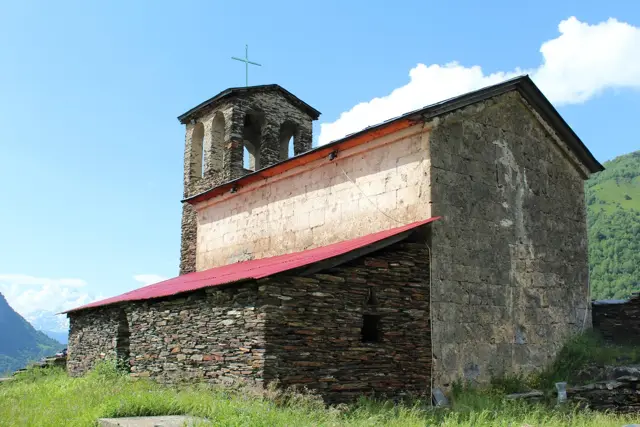
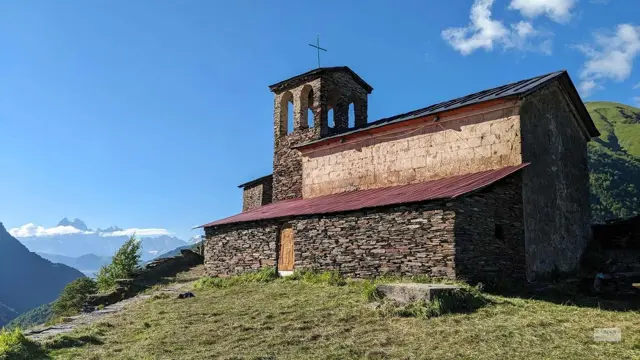
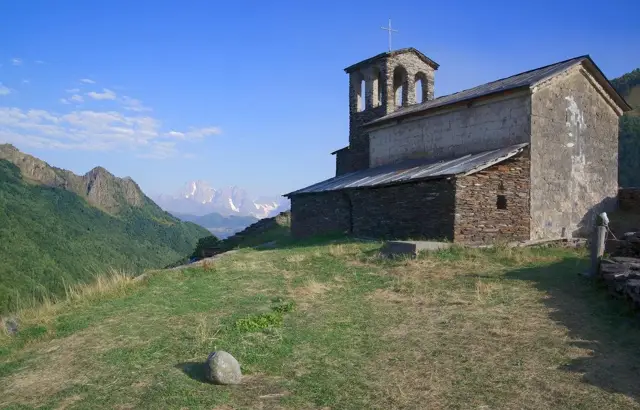
The present church dates mainly from the 10th century. It is a small single-nave church built of yellowish local stone. To the south and north it has annexes added later, and in its western part there is a two-storey bell tower. Historically the complex was also protected by a high stone wall, and other buildings for monastic use stood on the slope.
Lagurka's architecture is outwardly severe and modest. Here there are no monumental domes or rich façade decoration such as characterise the great Georgian cathedrals. Its beauty lies in simplicity, in the texture of the stone and in harmony with the mountain setting. Such compact architecture suited the harsh climate and high mountain conditions of Upper Svaneti well.
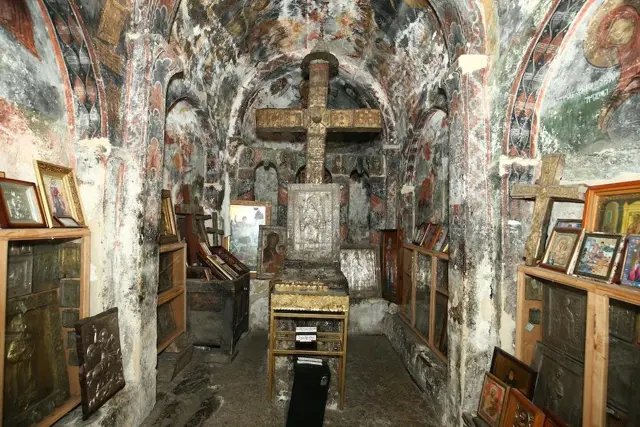
The church interior is small. The semicircular apse is separated from the main hall by a three-part stone chancel screen. Natural light enters only through a few small windows, and it is precisely in this half-light that Lagurka's greatest treasure, its medieval frescoes, makes an especially strong impression.
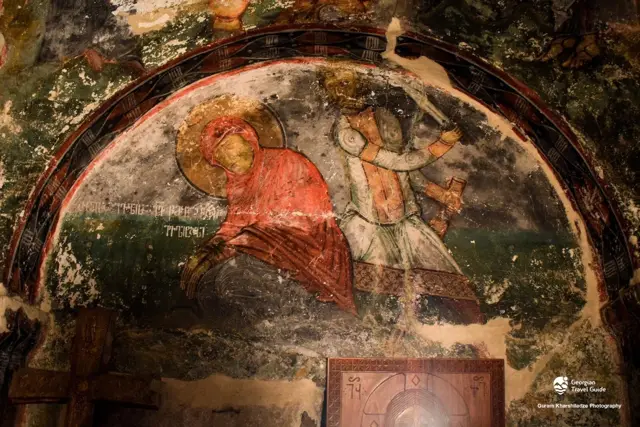
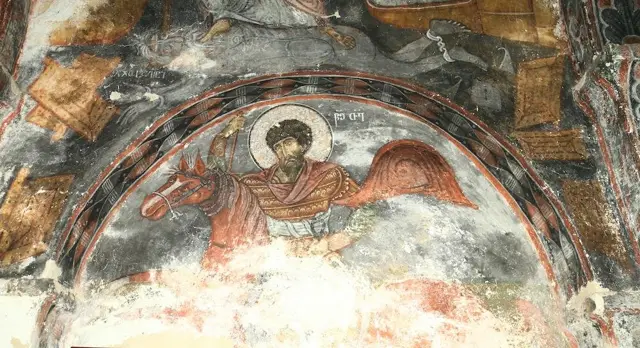
Lagurka's wall painting dates from 1111–1112 and is connected with the famous Georgian painter Tevdore. His name holds a special place in the history of medieval Georgian monumental painting. Tevdore is linked with the painting of several important churches in Svaneti, and the frescoes of Lagurka are regarded as one of the highest achievements of his work.
The Georgian inscription preserved in the church keeps important information about the period when the painting was made and about those who commissioned it. It is on the basis of these inscriptions, the artistic style and comparison with Tevdore's other works that researchers attribute the painting of Lagurka to this famous master.
The fresco programme is varied. On the walls are the Nativity of Christ, the Baptism, the Crucifixion and scenes connected with the Resurrection. Various saints are also depicted, as well as the church's patrons, Saints Cyricus and Julitta. Especially important are the scenes of their martyrdom, which are directly linked with the church's dedication.
Tevdore's painting is distinguished by the expressiveness of its figures, its strong emotional character and the thoughtful arrangement of its compositions. In a small church the painter managed to create a single Christian narrative world in which each scene has its own place in the architectural space.
Lagurka's importance is increased still further by the fact that Svaneti's high mountain and relatively isolated setting helped preserve many medieval Christian treasures. For centuries icons, crosses, manuscripts and other church objects were kept here, some of which are unique examples of local Georgian art.
Among the treasures connected with Lagurka the so-called Shaliani icon is mentioned by name, and it enjoyed great veneration in Svan church tradition. In general, for the Svans holy icons were not only works of church art: they were also part of the community's spiritual life, of oaths and of shared responsibility.
It is precisely here that Lagurka's difference from many other Georgian churches appears. For centuries it was not only a liturgical space but one of the main spiritual centres of Svan community life. An oath sworn at Lagurka had special force, and words spoken before the icons of the saints were taken with great responsibility.
The well-known Georgian historian and researcher Ekvtime Takaishvili stressed Lagurka's special importance. His description of the historical monuments and church treasures of Svaneti has preserved invaluable information about the cultural world protected for centuries in the mountains. In his descriptions Lagurka appears as a special symbol of Svan unity.
The most important day in Lagurka's spiritual life is Kvirikoba, the feast connected with the commemoration of Saints Cyricus and Julitta. It is celebrated every year on 28 July and is regarded as one of the important religious feasts of Svaneti. On this day believers and pilgrims gather at Lagurka and continue a tradition formed over the centuries.
Kvirikoba clearly shows that Lagurka is not merely a medieval monument turned into a museum. The church's historical significance is directly linked with present-day religious life. The same saints whose martyrdom took place almost seventeen centuries ago, and whose images Tevdore created on the church walls nine centuries ago, are still at the centre of the prayer of those who come here today.
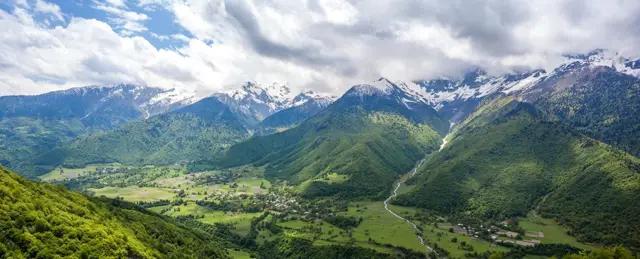
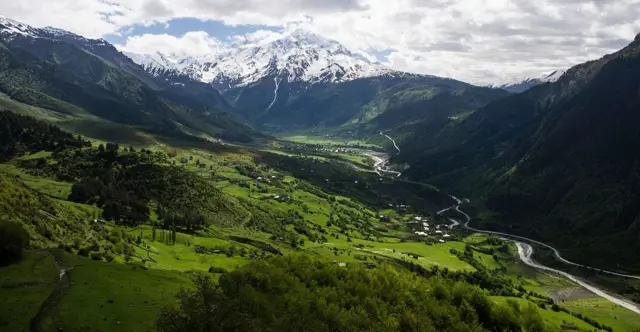
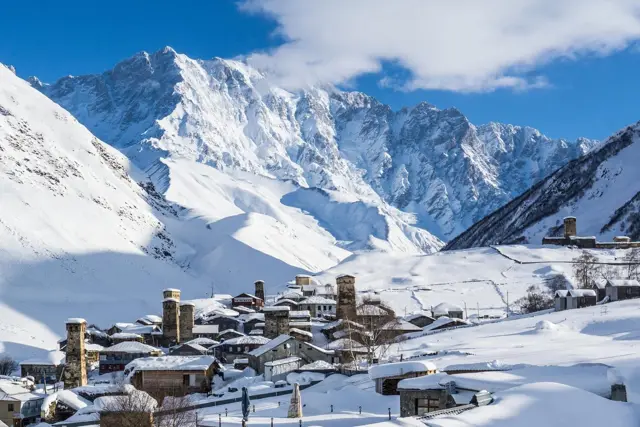
Lagurka's location also strengthens its spiritual character. To reach the church one has to pass through the high mountain setting of Svaneti. Below spreads the Enguri valley, and around are the mountains of the Caucasus and historic Svan settlements. In this space the small stone church seems to continue the mountain landscape naturally.
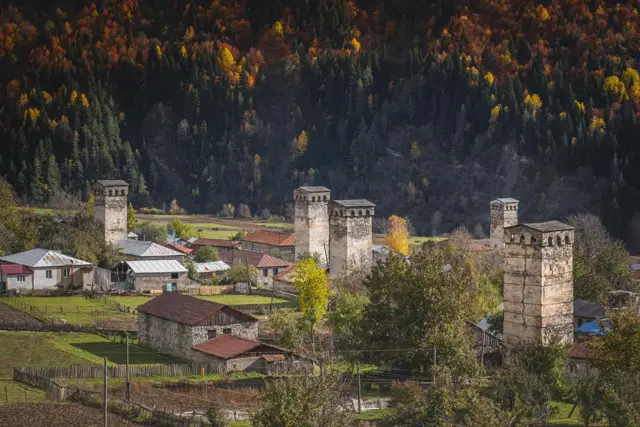
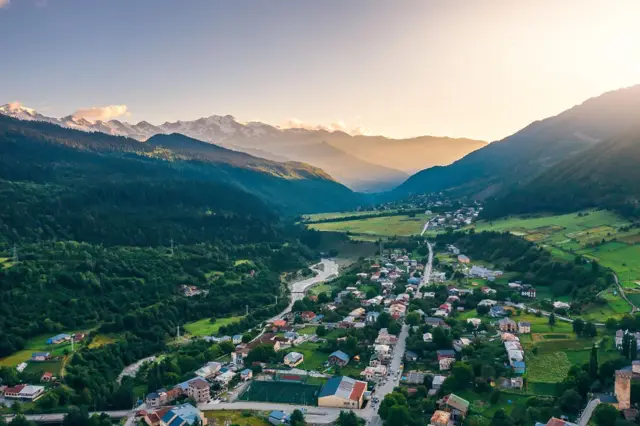
The village of Kala and its surroundings still preserve Svan towers, historic churches and traditional dwellings. That is why visiting Lagurka does not mean getting to know just one church: it introduces one to the centuries-old Christian and cultural world of Upper Svaneti.
Over the centuries Svaneti's natural isolation was at once a hardship and a means of protection. Harsh winters, difficult roads and mountainous terrain made daily life hard for the population, yet the same conditions helped many ancient churches, frescoes and church objects to survive.
Today the Church of Saints Cyricus and Julitta is an exceptional monument of Georgia's medieval cultural heritage and remains one of the most revered Christian places of prayer in Svaneti. Its significance is at once religious, historical and artistic.
Lagurka is a place where an astonishingly large part of Georgia's history is kept in a small stone church: the memory of early Christian martyrs, 10th-century Georgian architecture, Tevdore's unique frescoes of 1111–1112, medieval icons and the centuries-old religious traditions of the Svans.
The Church of Saints Cyricus and Julitta remains today a living symbol of the faith and unity of Svaneti: a small church raised in the high mountains, whose walls have kept for almost a thousand years the spiritual memory of Georgian Christian art, of prayer and of the mountain people.