Dariali Monastery of the Archangels
Where the rocks touch the sky and the Terek breaks the stones, there stands the Monastery of the Archangels: built of new stone, yet filled with eternal faith. God guards the gate of the Caucasus.
- Region
- Mtskheta-Mtianeti
- UNESCO
- No
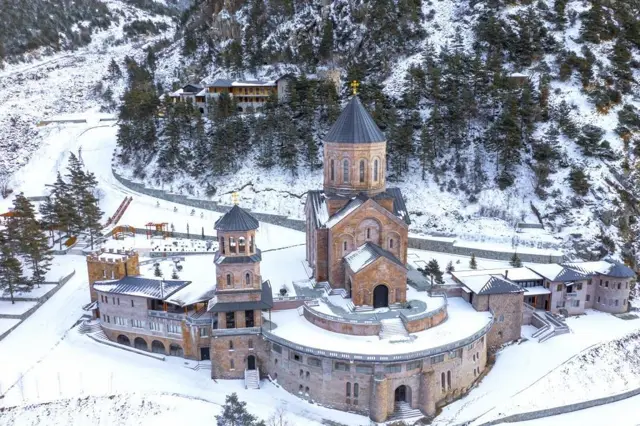
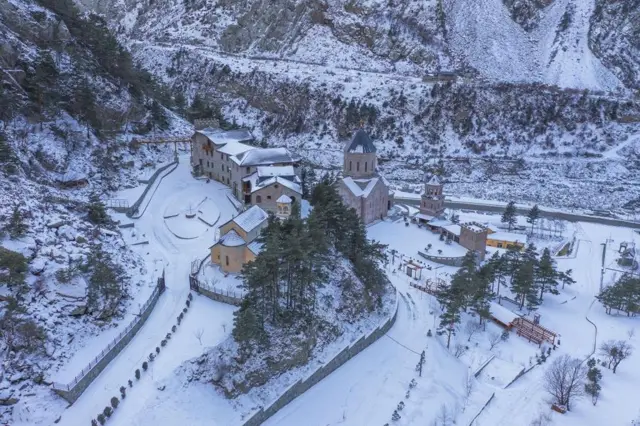
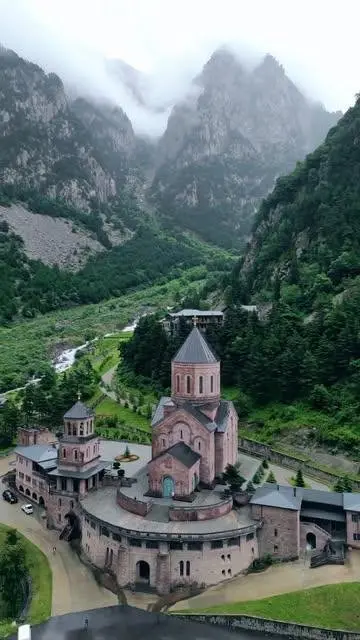
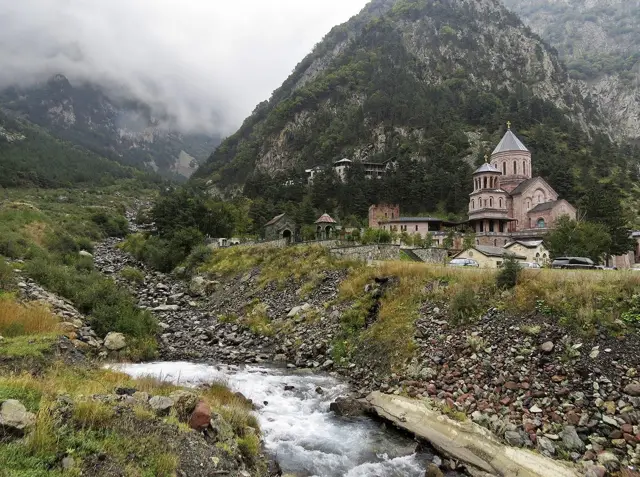
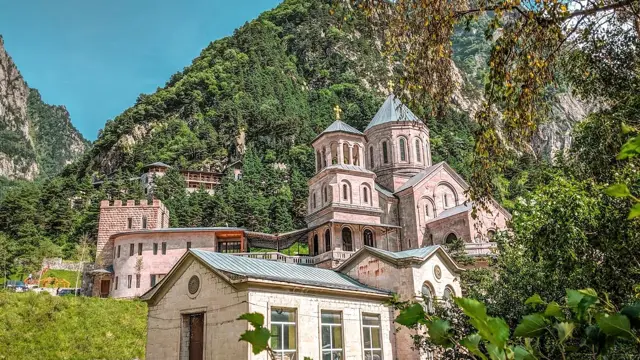
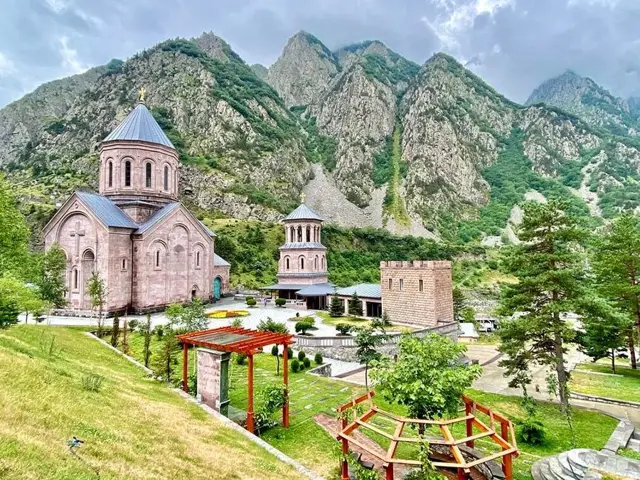
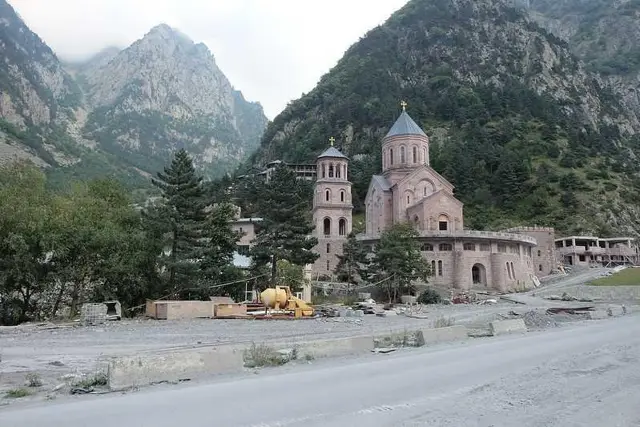
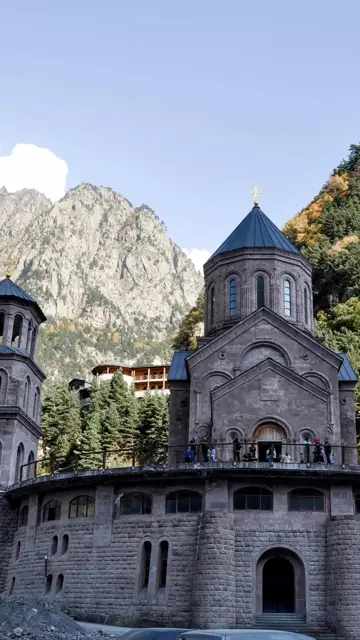
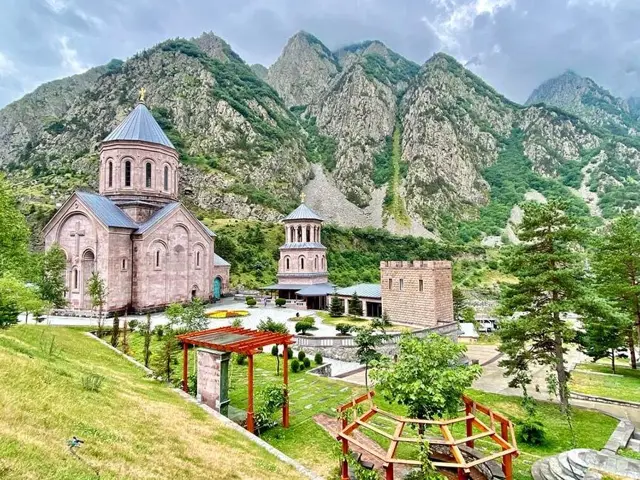
The Dariali Monastery complex of the Archangels is one of the most impressive modern Orthodox monasteries of Georgia. It stands in Mtskheta-Mtianeti, in the Kazbegi municipality, deep in the Dariali gorge, on the right bank of the river Terek, close to the state border between Georgia and Russia. Surrounded by huge cliffs, the monastery lies at about 1300 metres and is one of the first important Christian symbols on the road entering Georgia from the north.
Although the monastery complex itself was created in the 21st century, the place where it stands is linked with Georgia's centuries-long history. Since ancient times the Dariali gorge was one of the most important routes through the Caucasus mountain system, connecting the South Caucasus with the North Caucasus.
For centuries the narrow Dariali gorge had special military, political and commercial importance. It was precisely here that travellers, merchants, envoys and armies passed. Control of the gorge often meant control of Georgia's northern approaches as well.
Dariali's importance is evident as early as antiquity. In various periods of Georgian history the defensive structures here were used to hold back dangers coming from the north. As early as the 1st century BC the gorge was controlled by the kingdom of Iberia, and in the 5th century Vakhtang I Gorgasali strengthened the defensive system in the direction of Dariali.
Traces of the historic Dariali fortress still survive in the gorge today. This structure in its rocky setting reminds us that many centuries before the modern monastery appeared, Dariali was the strategic gateway of northern Georgia.
The importance of the gorge was especially great in the Middle Ages, when by this route Georgia maintained political, economic and cultural relations with the North Caucasus. Dariali was therefore not only a line of defence: it was also a road connecting different peoples and regions.
It was in precisely this historical setting that the modern Dariali Monastery of the Archangels was created. Its construction began in 2005 on the initiative of the Catholicos-Patriarch of All Georgia, Ilia II. The idea of creating the monastery had special symbolic meaning: a new, living Orthodox spiritual centre was to take shape at the historic northern gateway of Georgia.
The project for the monastery complex was large in scale from the outset. It did not mean building just one church: the overall plan envisaged twelve churches. Members of the monastery themselves took part in building and decorating the complex, including stone working, creating mosaics and artistic metalwork.
One of the most important stages came in 2011, when the Church of the Archangels was consecrated and began to function. In September 2011 the Catholicos-Patriarch of All Georgia, Ilia II, celebrated the Divine Liturgy here.
The main church is dedicated to the holy Archangels Michael and Gabriel. In Orthodox tradition the Archangel Michael is especially associated with leading the heavenly hosts, defending God's justice and fighting evil, and the Archangel Gabriel with bringing God's great messages to people.
That is why raising a church dedicated precisely to Michael and Gabriel at Georgia's historic northern gateway carries strong symbolic weight. A place that for centuries was a route of the country's defence and of contact with the outside world has become in modern times a centre of prayer and spiritual life.
A special place in the complex is also held by the church of the Hundred Thousand Martyrs of Tbilisi. The commemoration of the hundred thousand martyrs is linked with the martyrdom of Christians after the capture of Tbilisi by Jalal al-Din in 1226, and it remains one of the strongest symbols of faithfulness in Georgian church memory.
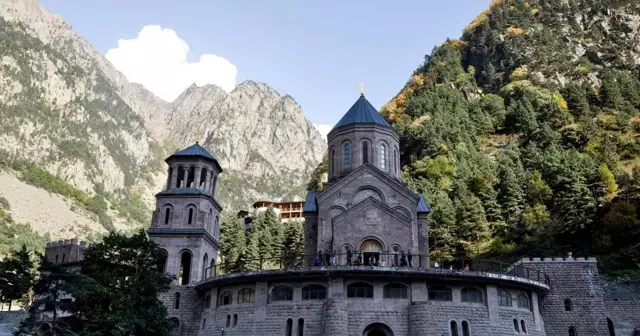
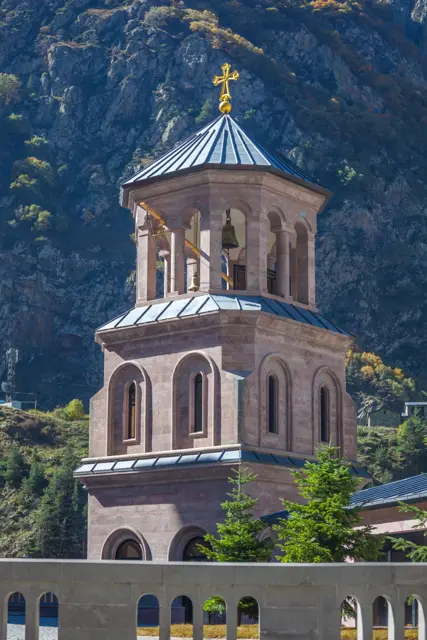
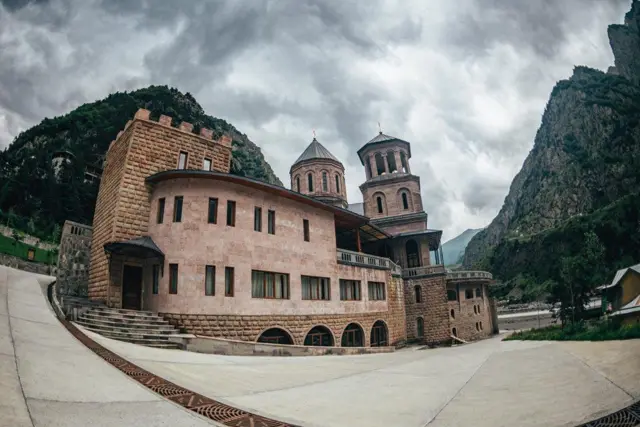
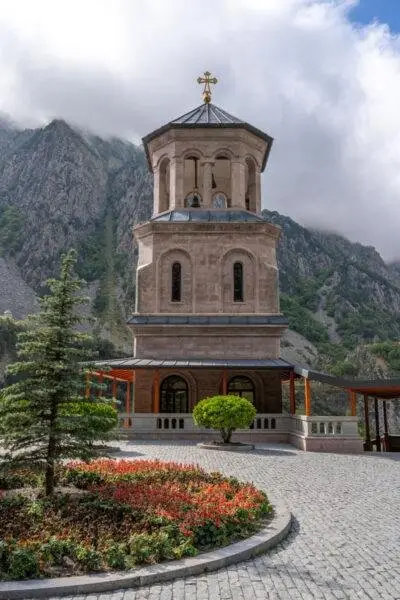
Architecturally, the Dariali monastery complex unites modern construction with the tradition of medieval Georgian church architecture. Although the churches were built in the 21st century, their proportions, use of stone, domed forms and decorative solutions create a conscious link with historic Georgian architecture.
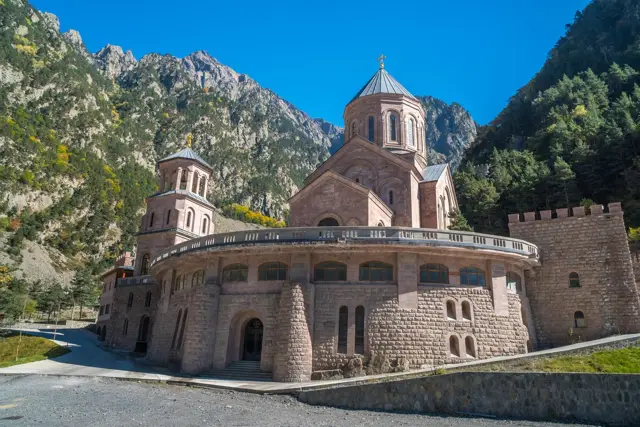
The architectural concept of the main church is especially interesting. Its proportions are inspired by Nikortsminda Cathedral, built at the beginning of the 11th century and regarded as one of the outstanding masterpieces of medieval Georgian architecture. Thus the modern church of Dariali creates an architectural dialogue with Georgia's almost thousand-year-old church tradition.
The stone used in building the church gives it a natural and monumental appearance. Together with the massive cliffs of the Caucasus, the colour and texture of the stone create the impression that the monastery is a continuation of the mountain landscape itself.
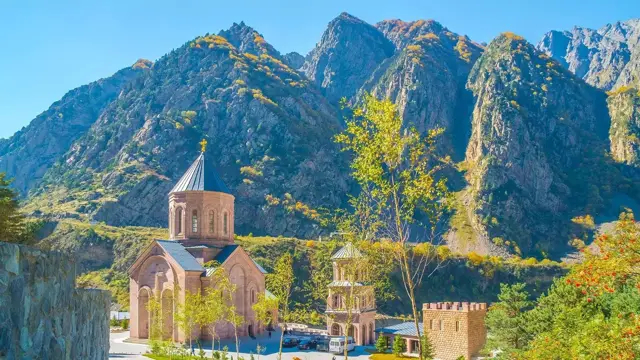
To appreciate Dariali's architecture fully, seeing the church façades is not enough. One of the main features of the complex is precisely its relationship with the landscape. The huge mountains rising on both sides surround the monastery almost like natural walls, while below flows the river Terek.
In this setting the scale of the Caucasus is felt with special intensity. The church's stone architecture seems relatively small against the huge mountains, yet it is precisely this contrast that creates Dariali's special beauty and spiritual atmosphere.
In the monastery's interior too the present-day tradition of Georgian Orthodox art continues. Icon painting, mosaic, artistic stone working and metal chasing are used in decorating the complex. These elements link the modern church with the centuries-old tradition of Georgian church art.
Dariali is not only a group of churches for prayer. The functioning monastery complex also has the spaces needed for the monks' daily life and work. The monastery's main purpose is not tourism but prayer, worship and monastic life.
For a tourist Dariali may be above all impressive architecture and a panorama of the Caucasus, but constant spiritual life goes on in the monastery. It is precisely this that distinguishes it from a mere modern architectural monument.
Dariali's recent history has also been touched by natural hazards. The gorge has a difficult geological setting, and the danger of heavy rains, landslides and mudflows here is real. The steep mountain slopes and the river valley make this place at once astonishingly beautiful and vulnerable to natural processes.
The monastery's location has another special significance for modern Georgia. It is close to the Dariali–Lars border crossing. When entering Georgia from the north, this complex is one of the first large Georgian Orthodox buildings the traveller sees in the gorge.
That is why the image of a "spiritual gateway of northern Georgia" emerges here especially naturally. Centuries ago fortresses and defensive works on this road guarded the country's northern entrance, and today the Monastery of the Archangels stands in the same historical space.
The monastery's location is also directly linked with the well-known Georgian Military Road, which connects Tbilisi with the North Caucasus across the Caucasus range. Over the centuries the political and economic importance of this route changed, but the Dariali gorge remains one of Georgia's main northern transport corridors.
Whoever comes to the Dariali Monastery sees several historical layers of Georgia at once: an ancient natural road through the Caucasus, traces of a medieval defensive system and an entirely modern Orthodox monastery complex.
Today the Dariali Monastery of the Archangels is a functioning Orthodox monastery. Services are held here regularly, monastic life goes on and believers come to pray from various parts of Georgia. At the same time many foreign visitors also come to the monastery.
Dariali's distinctiveness lies in the fact that two entirely different times of Georgian history meet here. On one side is the ancient Dariali gorge, whose roads and strongholds protected and connected Georgia for centuries; on the other is a 21st-century monastery that gives the same space a new spiritual meaning.
The Dariali Monastery of the Archangels is today a place where Georgian Orthodox tradition, modern church architecture and the centuries-old history of the Caucasus become a single whole. From the defensive gateway of Dariali in the age of Vakhtang Gorgasali to the modern monastery complex created on the initiative of Ilia II, this gorge still keeps its special importance as Georgia's northern gateway.
Dariali Monastery is a modern holy place raised among the cliffs of the Caucasus: a place where prayer offered in the name of the holy Archangels, Georgia's historic northern gateway and the monumental beauty of the mountains meet.