Samtavisi Cathedral
In the heart of Shida Kartli, on the bank of the Lekhura, the cathedral of Samtavisi has stood for almost a thousand years, like a chronicle in stone of faith and Georgian art. Earthquakes, wars and centuries altered its walls, yet the church rose again each time: a sanctuary of stone that neither time nor trial can overcome.
- Region
- Shida Kartli
- UNESCO
- No
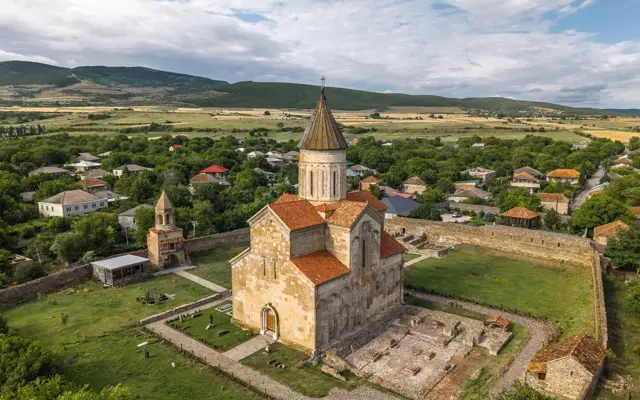
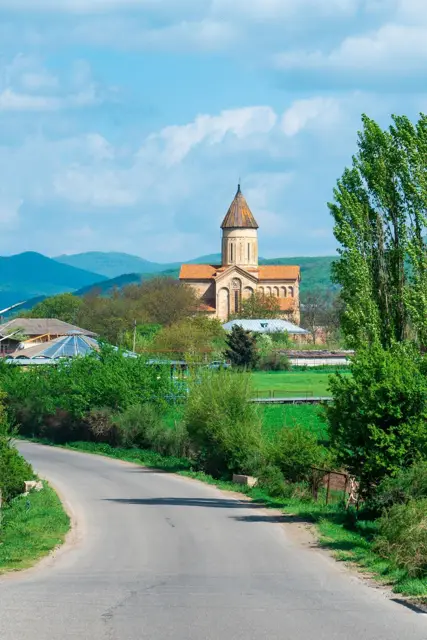
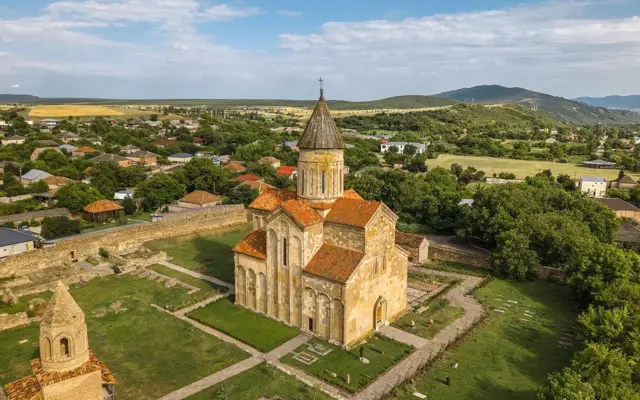
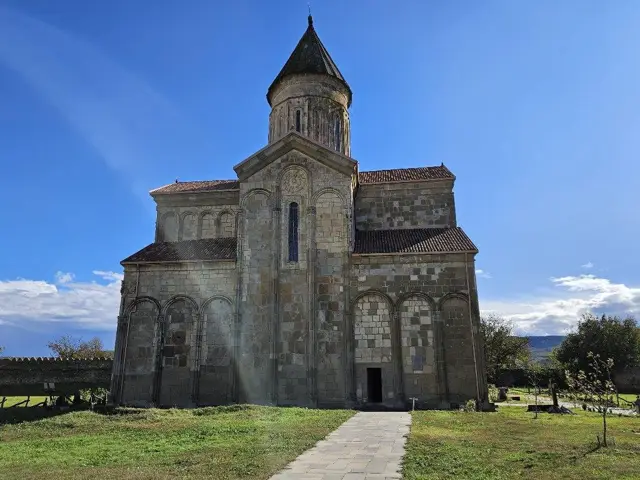
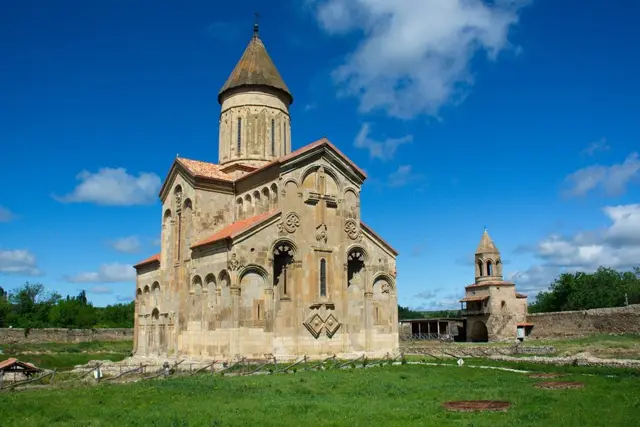
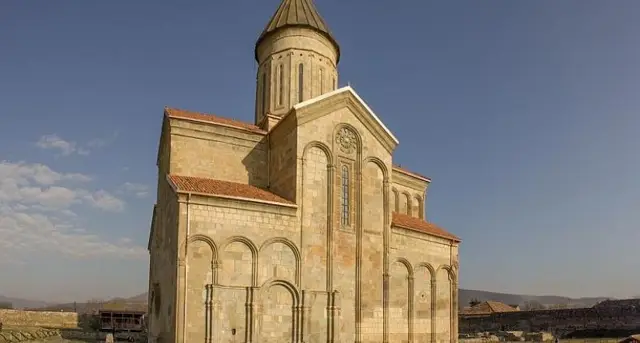
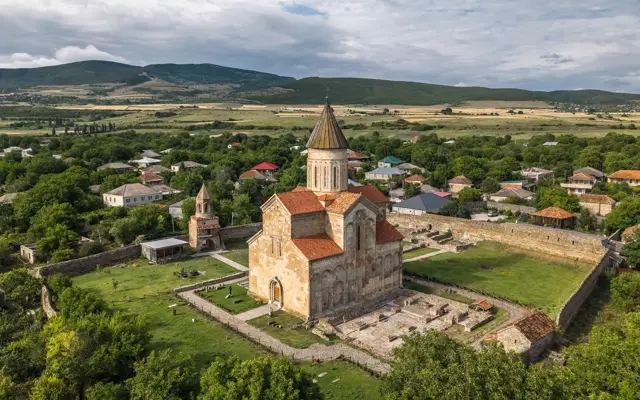
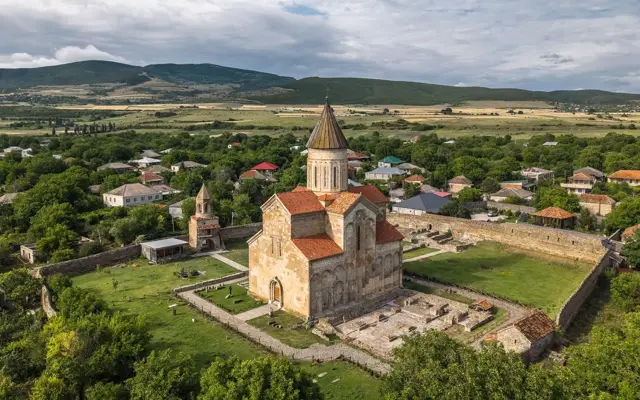
Samtavisi Cathedral is one of the most important monuments of medieval Georgian church architecture. It stands in Shida Kartli, in the village of Samtavisi in the Kaspi municipality, on the left bank of the river Lekhura. The present magnificent cathedral was built in 1030 and holds a special place in the history of Georgian architecture. Its proportions, the refined stone carving of its façades and an entirely new decorative solution proved so influential that Samtavisi became a kind of architectural model for many Georgian churches of later centuries.
Yet the spiritual history of Samtavisi begins long before the 11th century. Georgian Church tradition links this place with Saint Isidore of Samtavisi, one of the Thirteen Assyrian Fathers, who came to Georgia in the 6th century and played an enormous role in strengthening the country's Christian life. According to tradition, Saint Isidore founded a monastery here and made Samtavisi the place of his labours. His tomb is also preserved by the sanctuary of the present church, which makes Samtavisi a special holy place.
Thus at Samtavisi two great ages meet: the monastic movement of the Assyrian Fathers of the 6th century and the cultural flowering of unified Georgia in the 11th century. The earlier buildings have not survived, but archaeological traces confirm that important church life existed on this site before the present church was built.
The year 1030 was a turning point in the history of Samtavisi. It was then that Ilarion Kanchaeli, bishop of Samtavisi, built the magnificent church whose main form still defines the appearance of the complex today. According to historical records and building inscriptions, Ilarion was not only the donor: he is also regarded as the church's architect. This places Samtavisi among the rare medieval Georgian monuments whose creator's name history has preserved.
The 11th century was a time of political and cultural strengthening for Georgia. It was in this period that monumental churches were built expressing the strength and Christian self-awareness of the unified country. Samtavisi is part of this great rise, but its significance is not defined only by the scale of the age: here the architect created an artistic system that greatly influenced the later development of Georgian church architecture.
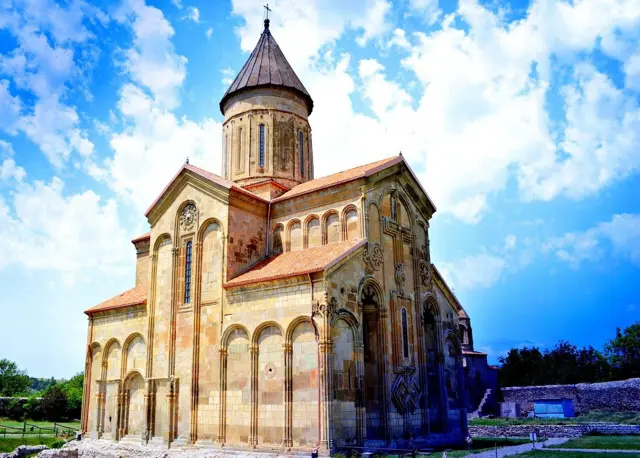
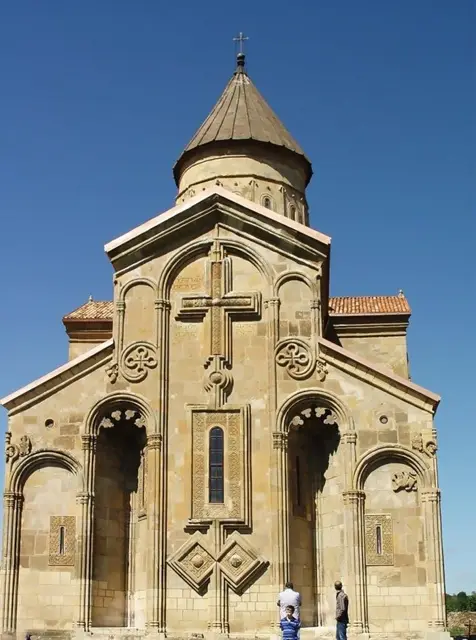
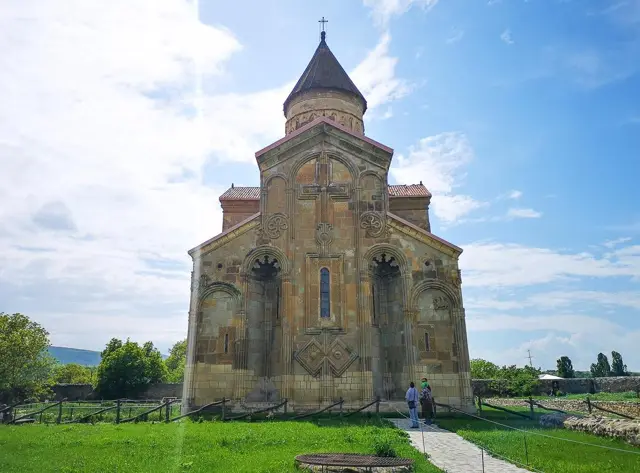
Samtavisi's east façade is especially outstanding. The great ornamental cross rising at its centre, the carved windows, the rhomboid decorations and the harmonious system of arches unite into one composition. A relief of a griffin also survives on the façade. This solution was such an important novelty for its time that similar decorative principles later spread to other Georgian churches as well.
At Samtavisi stonework reaches a special height. The carving is not merely wall decoration: it is an organic part of the architecture. Crosses, geometric ornaments, plant motifs and relief images turn the surface of the stone into a living fabric. That is why Samtavisi's east façade is considered one of the finest achievements of medieval Georgian stone carving.
The church is a domed building whose interior is based on a cross-domed system organised on four supports. Its forms unite monumentality and lightness at once. The high dome draws the space upward and creates in the interior the vertical aspiration especially characteristic of medieval Georgian churches.
The life of Samtavisi was never peaceful. Over the centuries the church endured strong earthquakes, political turmoil and various historical trials. As a result of especially severe damage, part of the dome, the west wall and the interior supports collapsed. Nevertheless, the church was not abandoned: Georgian nobles and clergy managed to restore it more than once.
The Amilakhvari family holds an important place in the church's history. In the 15th and 16th centuries they carried out the restoration and renewal of Samtavisi. The inscription preserved on the west façade names Gaiane as one of the restorers of the church. These restorations kept Samtavisi alive, although changes made over the centuries also altered some parts of the original architecture.
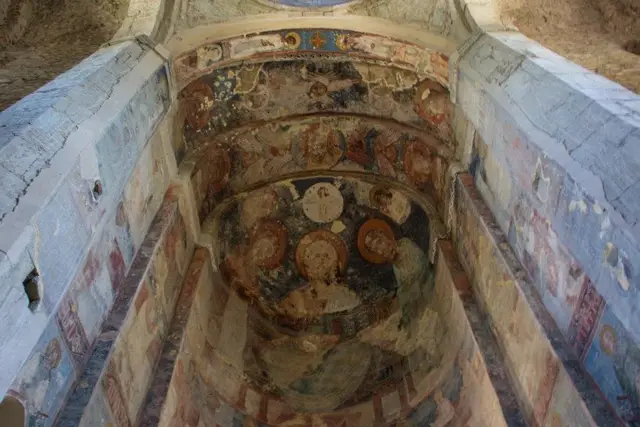
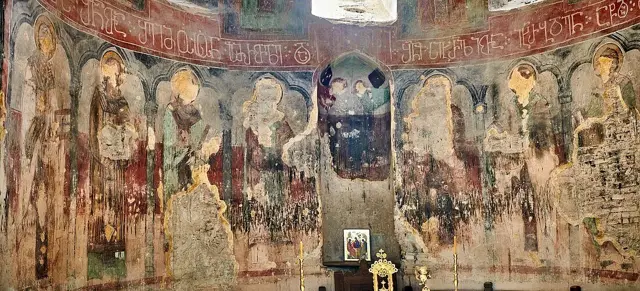
The frescoes are of special importance in the church's interior. Only fragments of the original 11th-century painting have been uncovered, while parts of the 17th-century painting survive more visibly today. In 1679 the church's painting was renewed. The dome and sanctuary showed Christ Pantocrator, seraphim, the evangelists, prophets, the Mother of God, archangels and Eucharistic scenes.
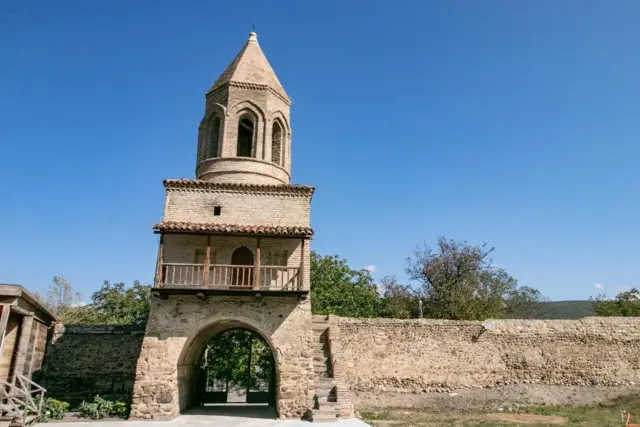
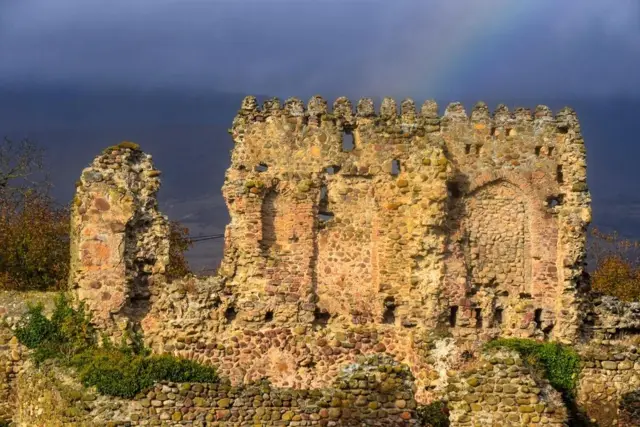
Samtavisi is not just one church. The historical complex includes an enclosure wall, a bell tower, a small church and the remains of the bishop's palace. The gate-belfry at the entrance gives the complex the appearance of a fortified church centre. Buildings from different periods preserved in the courtyard show that for centuries not only worship but also organised episcopal and monastic life took place here.
Restoration work was also carried out on the church in the 19th century. These interventions helped preserve the building, although some old decorative details were lost. Despite repeated alterations, the strength of the 11th-century master's original idea can still be felt, especially on the east façade.
Samtavisi's greatest spiritual treasure remains its connection with Saint Isidore of Samtavisi. His tomb inside the church joins the depth of the centuries to a living spiritual tradition. Here the pilgrim does not meet only a masterpiece of Georgian architecture: he enters a place that links Georgia's monastic history with the work of the Thirteen Assyrian Fathers.
Today Samtavisi Cathedral is a functioning Orthodox sanctuary and one of the most important cultural monuments of Georgia. It is included on the UNESCO World Heritage Tentative List, which once again underlines its outstanding architectural significance.
Samtavisi is the place where the prayer of a 6th-century Assyrian Father, the genius of an 11th-century Georgian architect and the labour of centuries to save the church are woven into one story. Earthquakes damaged its walls and time erased part of its painting, but they could not destroy the main strength of Samtavisi. Its great stone cross still stands on the east façade today, a silent sign of Georgian faith, art and historical memory.