Nikortsminda Cathedral
The church founded by the hand of Bagrat gave a voice to the stone of Racha: every ornament is carved like a prayer, every cross cries out to eternity. Centuries later, the colours that remained beneath the dome came to life again, as though time had never touched the faith.
- Region
- Racha
- UNESCO
- No
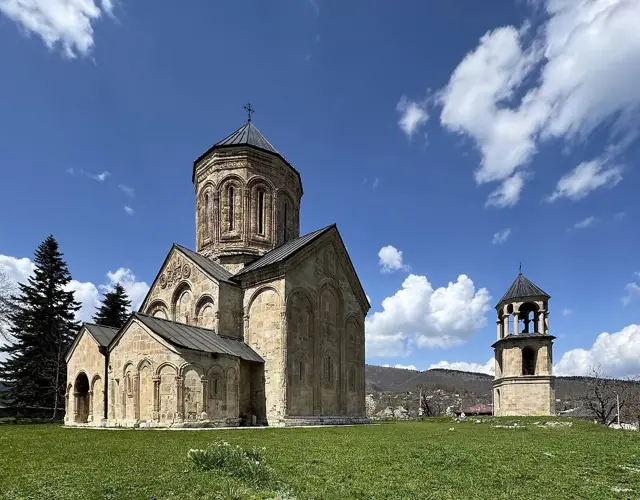
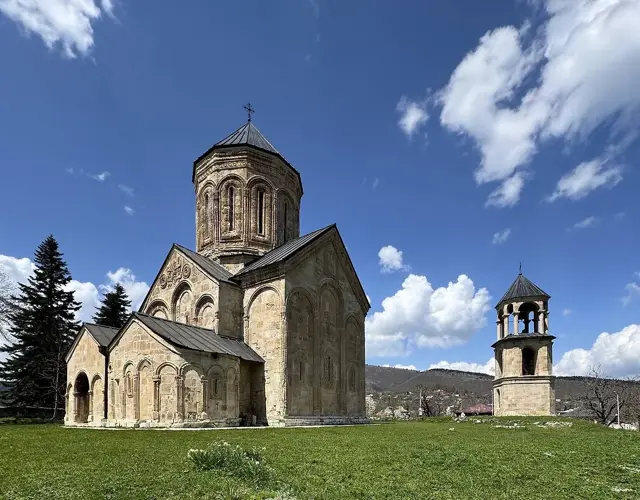
Nikortsminda Cathedral is one of the most outstanding monuments of medieval church architecture in Georgia. It stands in historic Racha, in the village of Nikortsminda in today's Ambrolauri municipality, and is consecrated in the name of Saint Nicholas. For almost a thousand years the cathedral was one of the main centres of Racha's spiritual life, yet its significance extends far beyond the region: Nikortsminda is regarded as one of the highest achievements of Georgian architecture, monumental sculpture and Christian art.
The building of the cathedral at the beginning of the 11th century, around 1010–1014, belongs to the reign of King Bagrat III of Georgia. This was an exceptional era in Georgian history. By uniting important political entities of western and eastern Georgia, Bagrat III laid the foundation of a united Georgian kingdom, and a period of new political and cultural ascent began in the country.
In the age of Bagrat III great importance was attached to church building. Several outstanding churches are connected with the king's name, among them Bagrati Cathedral in Kutaisi. Nikortsminda too was created in precisely this setting of political strengthening and cultural ascent. That is why it was not only a religious building: its scale and artistic quality also expressed the strength and Christian self-awareness of the united Georgian state.
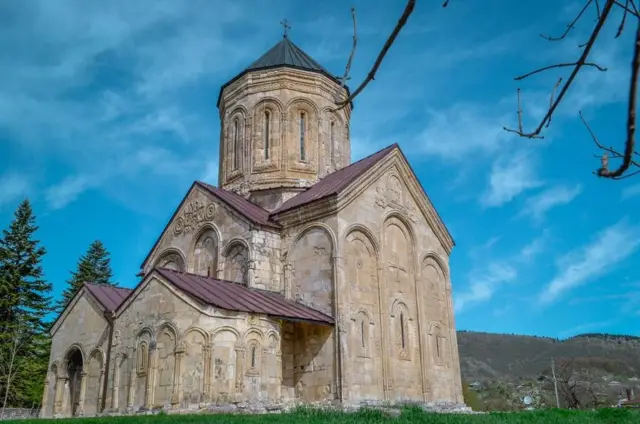
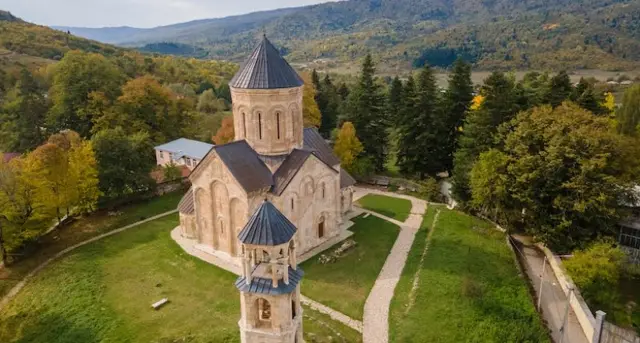
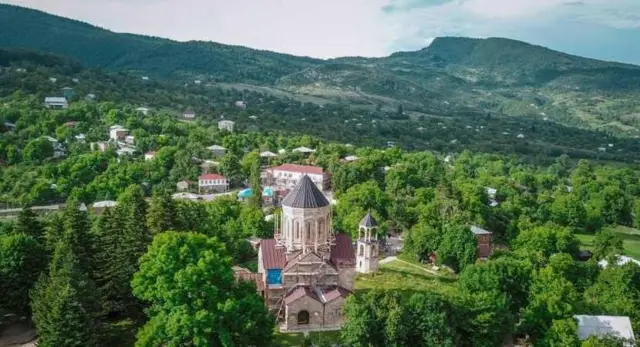
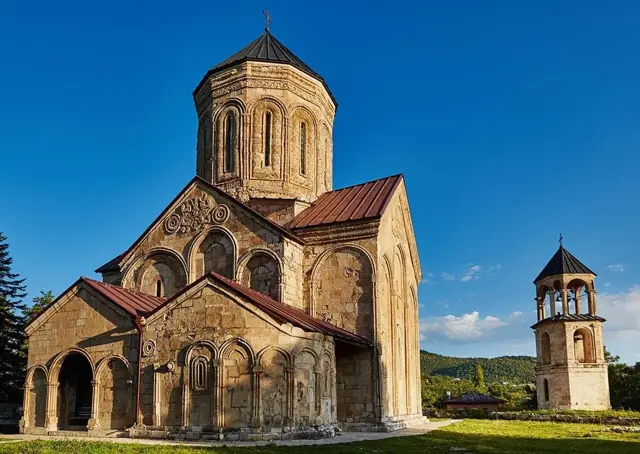
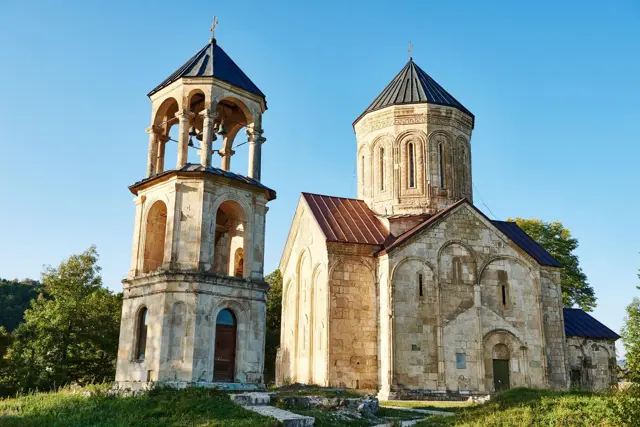
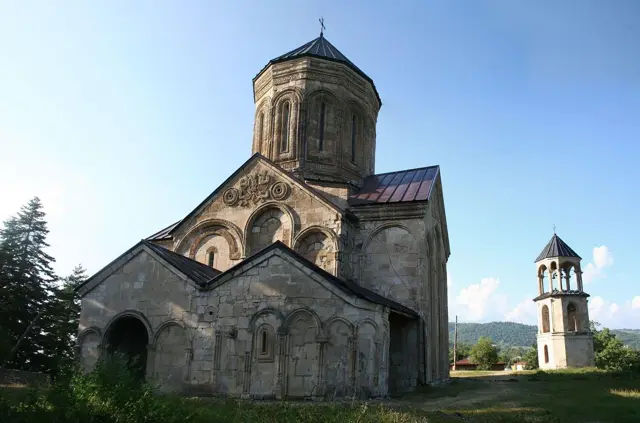
Architecturally, Nikortsminda is a domed church with a complex and unusually conceived plan. From outside its masses form a compact and harmonious whole, while inside the central space beneath the dome is surrounded by several apses. This spatial solution gives the church special plasticity and sets Nikortsminda apart from other medieval Georgian churches.
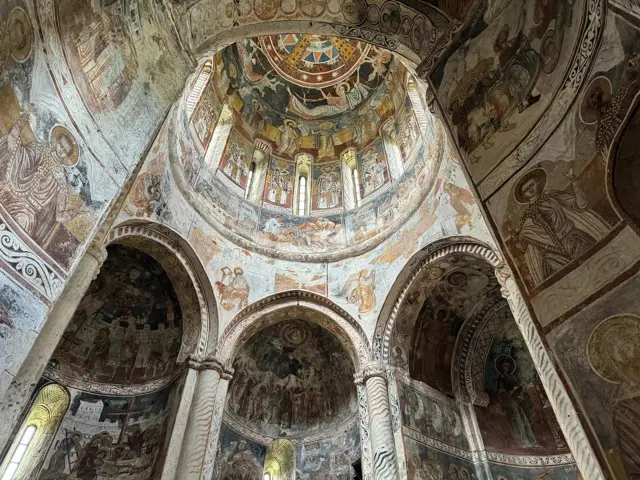
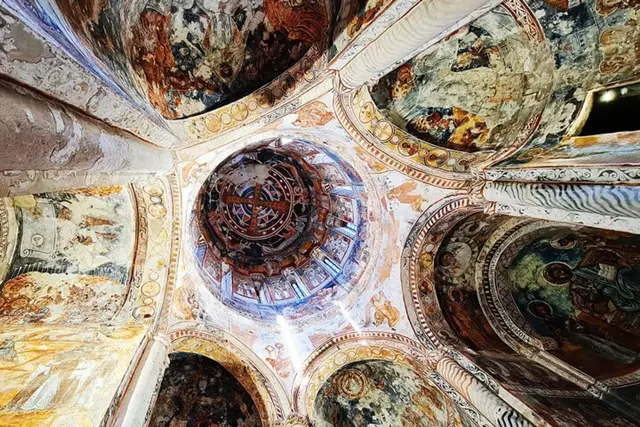
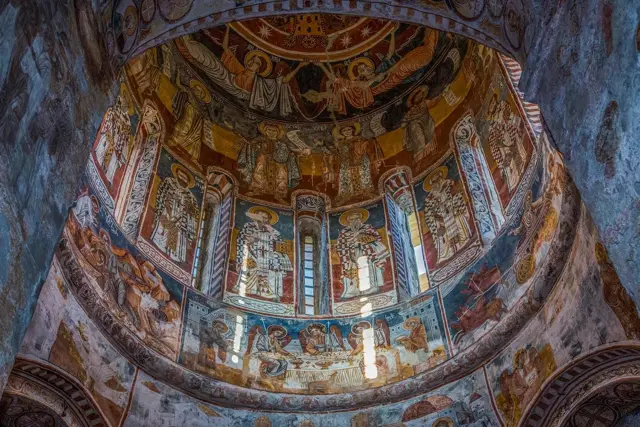
The central space of the church is crowned by a high dome. The drum of the dome is pierced by windows through which natural light enters the interior. The interplay of light and architectural forms gives the space a special spiritual character: the eye is naturally drawn towards the central part of the church and the dome.
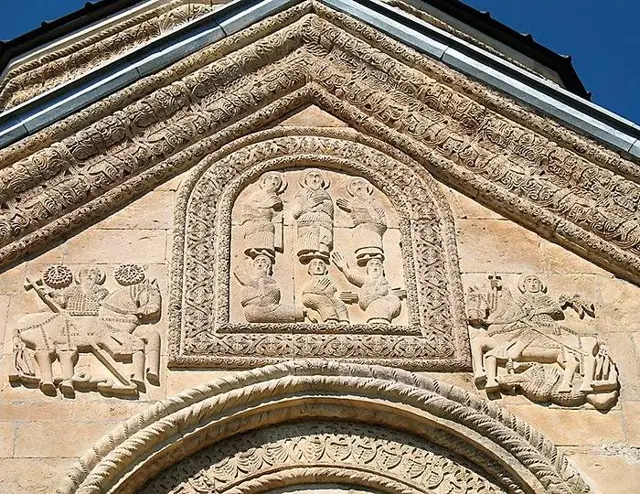
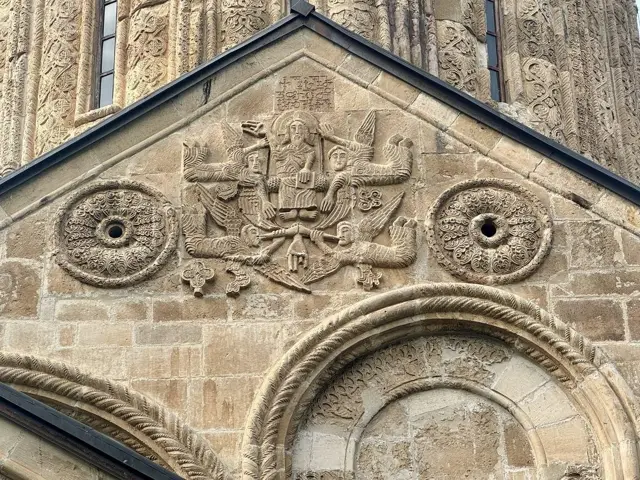
Yet the main reason for Nikortsminda's world significance is its stone decoration. The church's façades are so richly adorned with reliefs and carvings that Nikortsminda can be regarded as a kind of encyclopaedia of medieval Georgian stone carving.
Here stone is no longer simply a building material. Medieval masters turned the façades into an immense artistic surface where Christian theology, biblical subjects, ornament and symbolic images are united in a single system.
On the façades there are images of Christ, angels, saints, crosses, animals, birds and plant motifs. Special attention is given to the most important themes of the Christian world: compositions connected with the glory of Christ, the Transfiguration, the Exaltation of the Cross and the Second Coming.
One of the special features of Nikortsminda's reliefs is the astonishing precision of detail. The masters carved the stone deeply and created a multi-layered ornamental fabric. As the light changes, the shadows of the carvings change too, and the façades are perceived differently at different times of day.
The window frames, porches and upper parts of the façades are especially richly decorated. Interlaced plant ornaments, geometric forms and figural reliefs leave almost no significant architectural surface without artistic treatment.
There are almost no random elements in this decoration. In medieval Christian art plants, animals, birds, crosses and human figures often carried a specific symbolic meaning. That is why the façades of Nikortsminda were not created merely for decorative beauty: they are also a Christian message conveyed in stone.
The architectural history of the cathedral did not end in the 11th century. Later various buildings were added to Nikortsminda and some of its parts were renewed. Especially important was the period of the 16th–17th centuries, when significant work was carried out in the cathedral with the support of Racha's local princes and nobles.
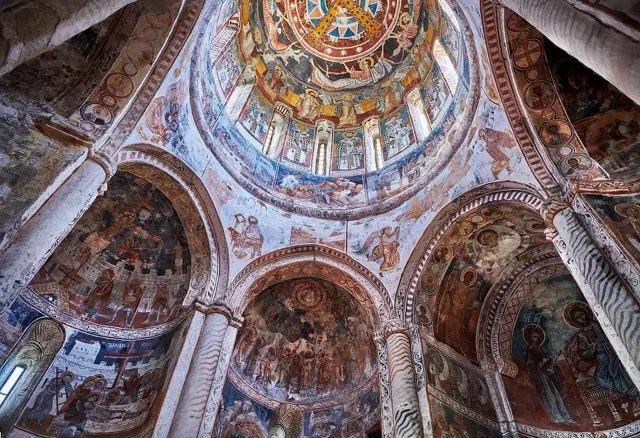
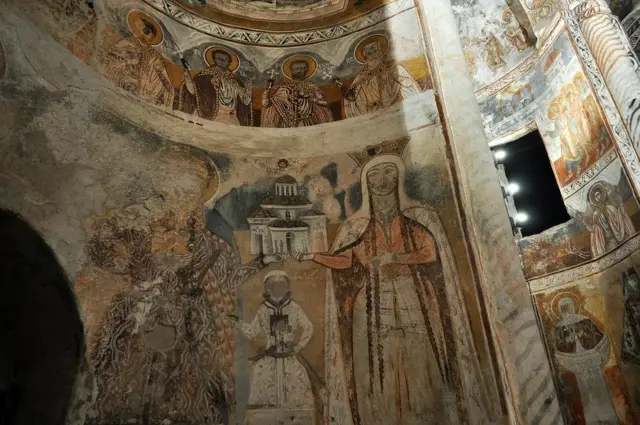
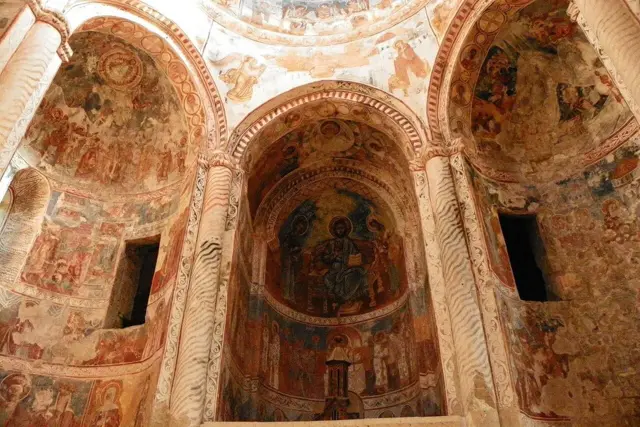
Another great treasure of Nikortsminda is linked with this period: its monumental fresco painting. An important part of the interior painting that survives today dates from the 17th century and is an outstanding example of late medieval Georgian church painting.
Inside the church an entirely different artistic world opens up. If outside the main impression comes from the monumentality of the stone and the richness of the reliefs, inside the space is filled with colour, biblical scenes and images of saints.
On the walls and vaults are depicted Christ, the Mother of God, the apostles, saints and various scenes from the Old and New Testaments. The painting follows the architectural space and forms a unified theological programme. For the believer the church interior became a visual world of Christian history and teaching.
In Nikortsminda's painting the relationship between Georgian artistic tradition and the wider Orthodox art of the period is especially interesting. The arrangement of the figures, the scale of the compositions and the colour system show that centuries later the cathedral still retained high church and cultural significance.
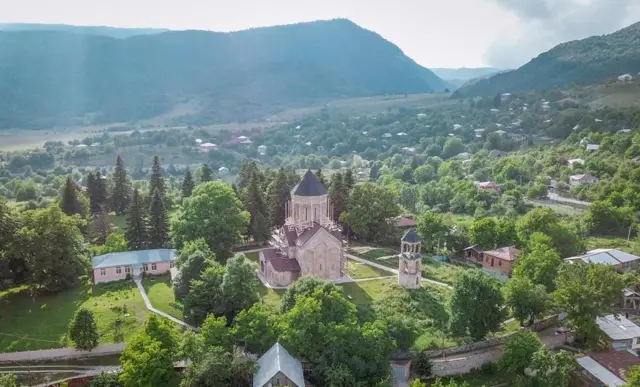
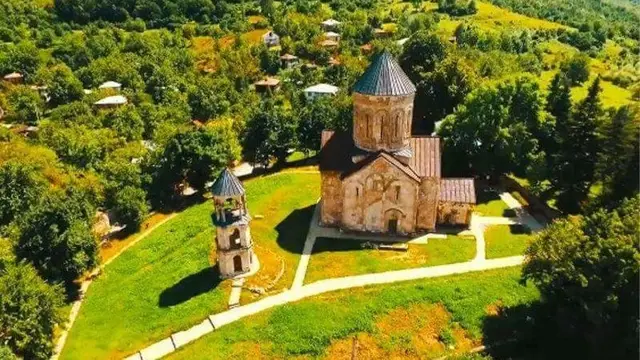
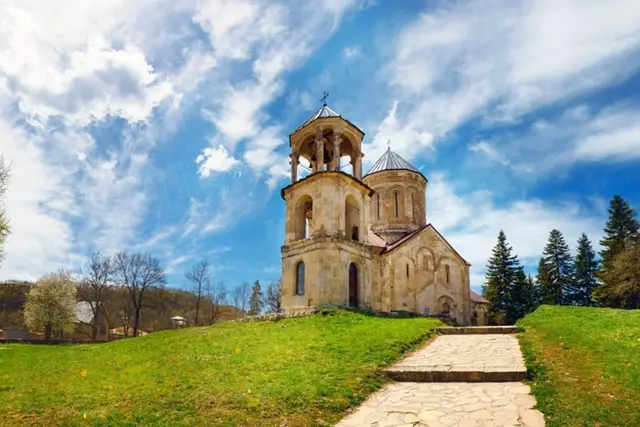
Near the cathedral stands the bell tower, which completes the historical appearance of the complex. It belongs to a later period and shows that for centuries Nikortsminda was a living church space to which each generation added its own architectural trace.
Nikortsminda was important not only as a place of prayer but also as Racha's church and cultural centre. Over the centuries believers gathered here, and services and major church feasts were celebrated. The existence of the cathedral became one of the main pillars of the region's Christian identity.
An important stage in its history was also the establishment of Nikortsminda as an episcopal see. In the late Middle Ages the church significance of the cathedral grew even further and it held a central place in the religious life of Racha.
The difficult political history of Racha was naturally reflected in Nikortsminda as well. Georgia broke up into various kingdoms and principalities, political power in the region changed and the country faced many foreign threats. Nevertheless, the cathedral survived and the tradition of worship continued.
In the 19th century Georgia's incorporation into the Russian Empire greatly changed the administrative situation of the Georgian Church. Some of the old Georgian eparchies were abolished or transformed, which also affected the life of regional church centres.
The Soviet period proved even harder, when the atheist state severely restricted religious life. Many Georgian churches were closed or lost their traditional function. Nikortsminda too became part of this historical reality, but its architectural and artistic importance was so great that the monument was preserved and also became an object of scholarly study.
Nikortsminda's significance is seen especially clearly when its exterior and interior are compared. From outside the church is an astonishing world of stone carving: a monumental building covered with reliefs, crosses and ornaments. Inside, however, the visitor enters an entirely different, colourful Christian world created by frescoes.
The unity of these two artistic languages gives Nikortsminda a special character. The 11th-century architecture and stone decoration show the cultural strength of united Georgia, while the frescoes of later centuries confirm that the spiritual life of the cathedral continued actively hundreds of years after it was built.
Nikortsminda's value is today recognised at international level as well. The cathedral is included on the UNESCO World Heritage Tentative List, which underlines its special architectural and cultural importance.
Today Nikortsminda Cathedral is a functioning Orthodox holy place. Services are still celebrated here, and pilgrims come both from Racha and from other parts of Georgia. At the same time it is visited by architects, art historians, historians and travellers who come to see one of the most impressive monuments of medieval Georgian art.
Racha's own nature strengthens Nikortsminda's special atmosphere. Surrounded by mountains and forests, the cathedral has stood for centuries in the same landscape in which it was built at the beginning of the 11th century. This unity of stone architecture and the natural setting of the Caucasus gives Nikortsminda an even more distinctive appearance.
Nikortsminda Cathedral is a place where several of the greatest achievements of medieval Georgian culture are gathered in one space: the complex architecture of the 11th century, unique stone carvings and reliefs, the fresco painting of later centuries and a Christian tradition almost a thousand years old.
From the age of Bagrat III to today's functioning church, Nikortsminda has passed through more than a thousand years of history. Its stone walls still keep the handwriting of the masters who turned plain stone into a true masterpiece of Christian art. That is why Nikortsminda remains today one of the greatest treasures of the architectural, spiritual and cultural heritage not only of Racha but of all Georgia.