Ateni Sioni
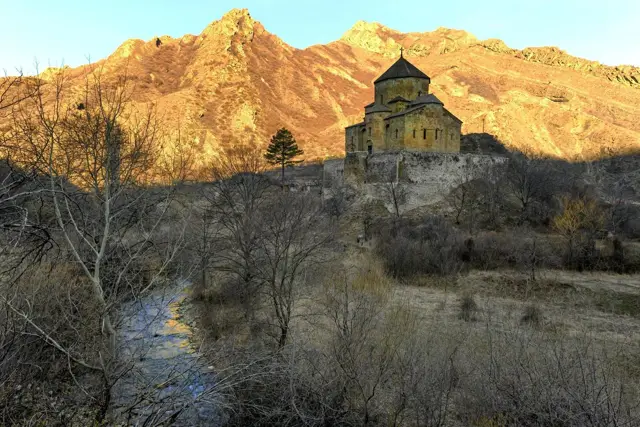
In the gorge of Ateni, where the mountains enfold the church, Christ and the saints have looked down on us from the walls since the 7th century. The frescoes lose their colour, but the word remains: carved in stone, saved from the centuries.
- Region
- Shida Kartli
- UNESCO
- No
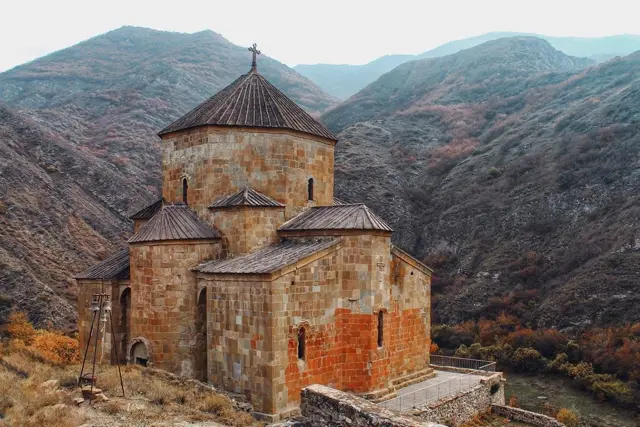
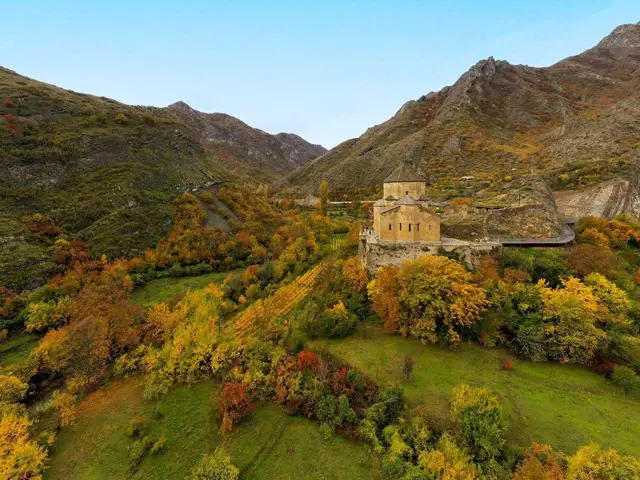
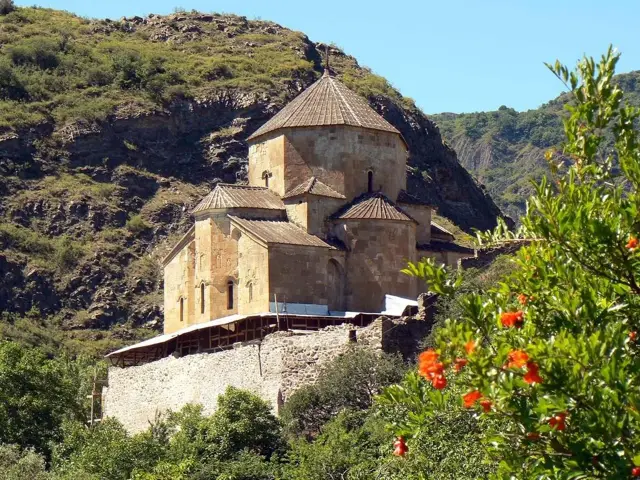
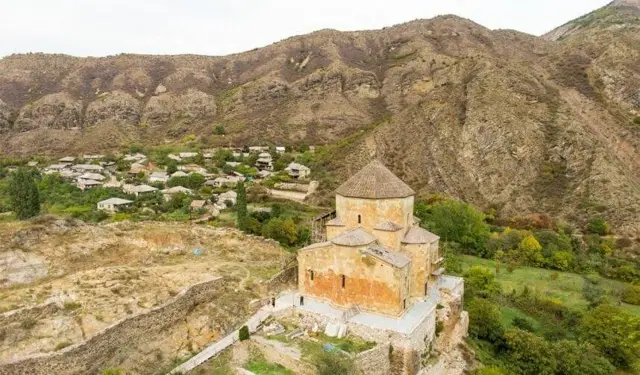
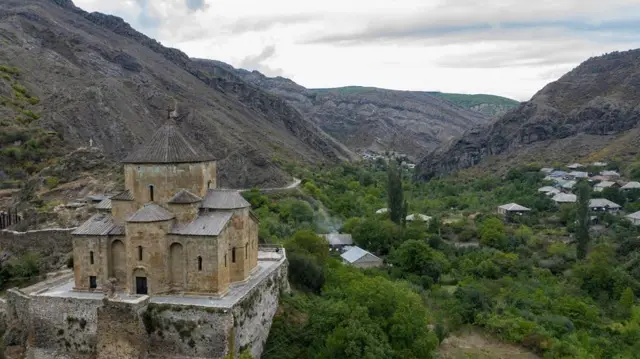
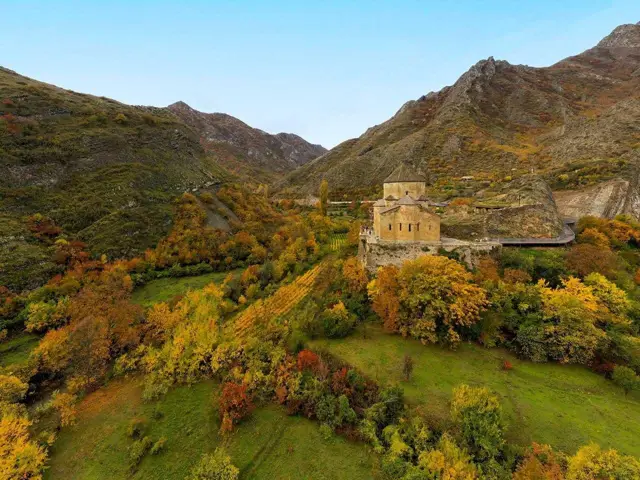
Ateni Sioni is one of the most important early medieval Orthodox churches of Georgia. It stands in Shida Kartli, in the Gori municipality, in the Ateni gorge, the valley of the river Tana, on a rocky height. Surrounded by nature, the church was for centuries not only a place of prayer but also an important centre of Georgian culture, writing and historical memory.
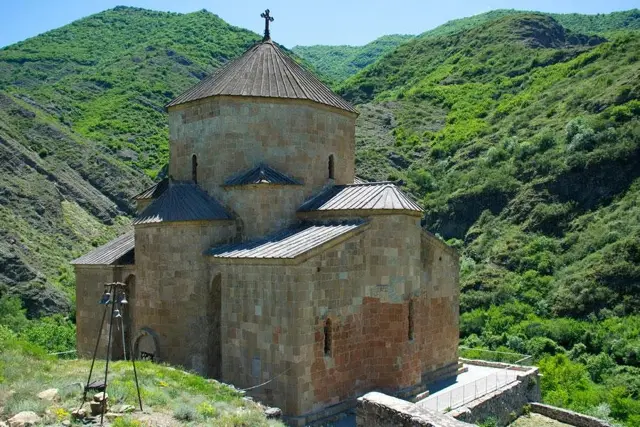
The special importance of Ateni Sioni lies first of all in its age and architecture. The church was built at the beginning of the 7th century and represents one of the most important stages in the development of Georgian cross-domed architecture. Its plan and architectural forms are so close to the Jvari monastery of Mtskheta that Ateni Sioni is often regarded as one of the most outstanding examples of the so-called "Jvari type" churches.
Architecturally, Ateni Sioni is a domed church of the tetraconch type. Four apses are arranged around the central space, and the niches between them create a complex yet harmonious spatial structure. This solution speaks of the high engineering and artistic level of early Georgian Christian architecture.
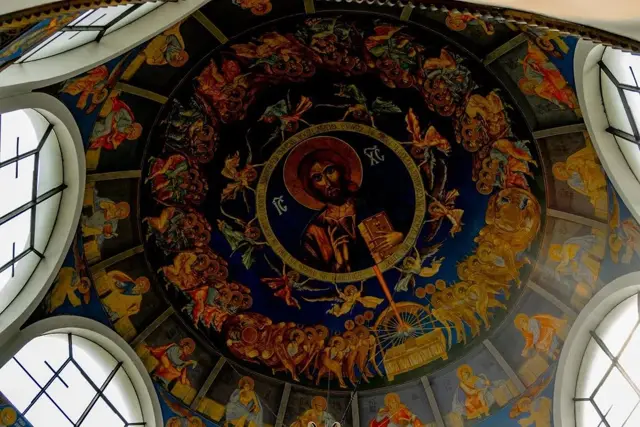
The church's dome gives the central space special height. The interior is organised so that the worshipper's attention is naturally drawn upwards, towards the dome and the sanctuary. It was precisely this understanding of space that became one of the characteristic features of medieval Georgian church architecture.
The influence of the Jvari of Mtskheta is clearly felt in the architecture of Ateni Sioni, yet the church is not a mere repetition. Georgian builders reworked the already established architectural model to suit the particular terrain and setting and created an independent artistic image.
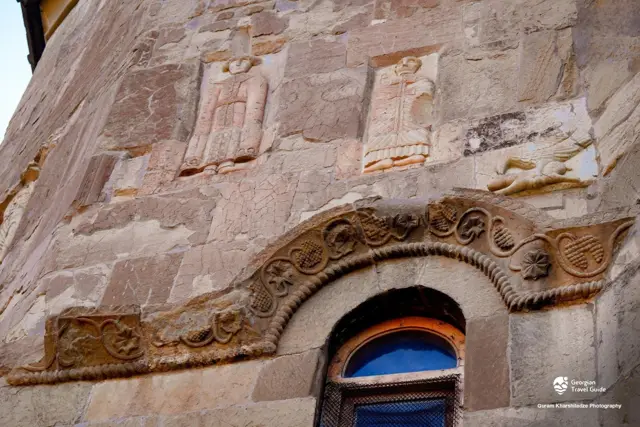
The church façades are especially interesting for their stone reliefs and ornamental decoration. Here there are crosses, plant motifs, images of animals and figural compositions. Some reliefs carry Christian symbolism, while others are an interesting reflection of medieval life and artistic ideas.
One of the best-known relief compositions shows scenes with deer. In Christian art a deer coming to a spring is often seen as a symbol of spiritual thirst and longing for God. Such images show that the decoration of Ateni Sioni did not serve only as ornament: it also created a visual language of Christian thought.
Connected with the church's history is also the name Todosak, mentioned in an Armenian inscription on the south façade. Researchers do not agree on his exact role or on the date of the inscription: it may be linked either with the building of the church or with a later restoration. For this reason the information is treated with caution.
The restoration work of the 10th century also holds an important place in the history of Ateni Sioni. In this period certain elements of the upper parts and façades of the church were renewed. The various works carried out over the centuries created several historical layers in its architecture, although the main 7th-century structure can still be read clearly.
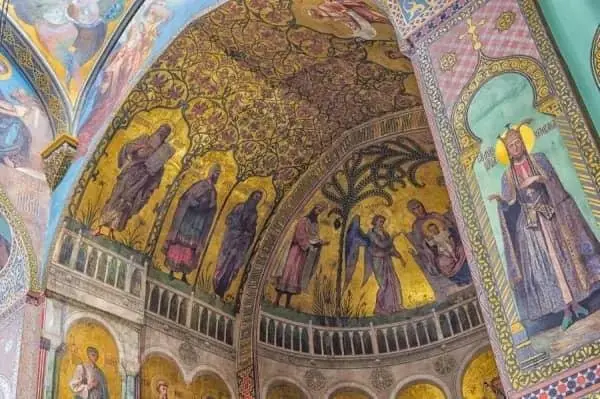
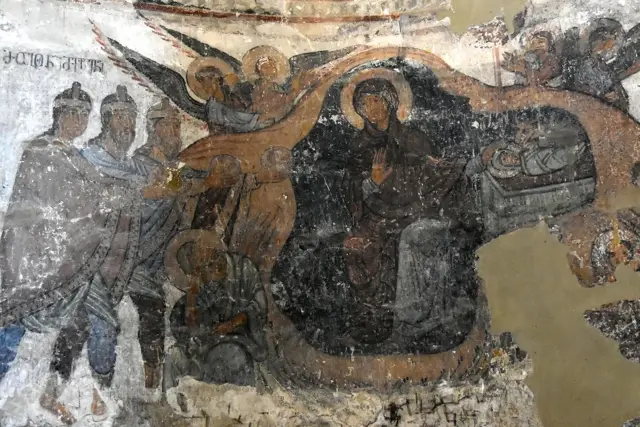
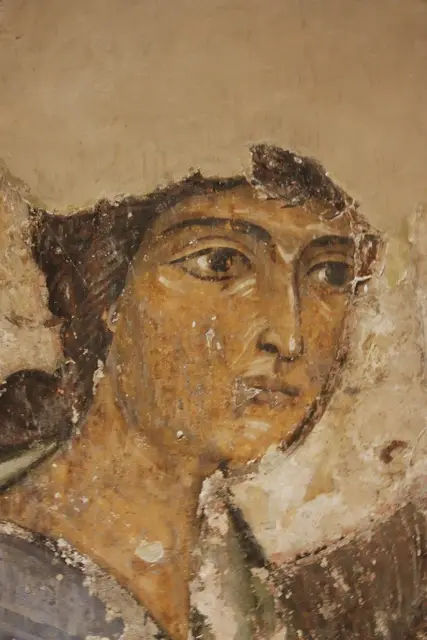
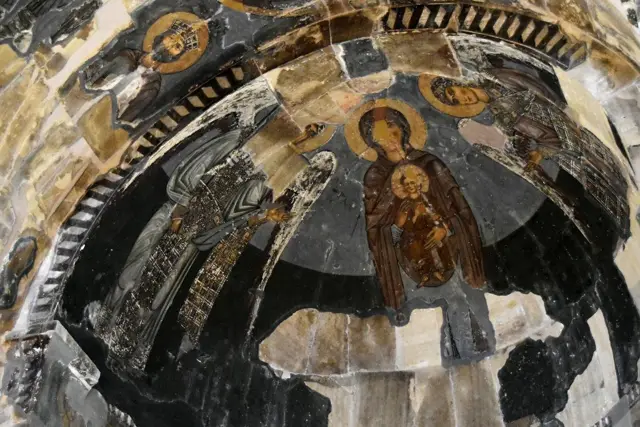
If from outside Ateni Sioni amazes us above all with its architecture and stone decoration, inside its main treasure is its medieval wall painting. The frescoes preserved in the interior are considered one of the most important ensembles of Georgian monumental painting.
An important part of the church's painting belongs to the 11th century. The frescoes form a varied Christian programme and include images of Christ, the Mother of God, the apostles, the prophets, the saints and various biblical scenes. In each apse the painting is in harmony with the architectural purpose of the space.
The frescoes are distinguished by clear outlines, movement of the figures, expressive faces and harmony of colour. The painters used the architectural space in such a way that the whole interior was transformed into a single Christian artistic world.
It is also especially important that images of historical figures are preserved in the wall painting. Such portraits allow researchers not only to study medieval Georgian art but also to understand better the history of the church's patrons and the political setting of that age.
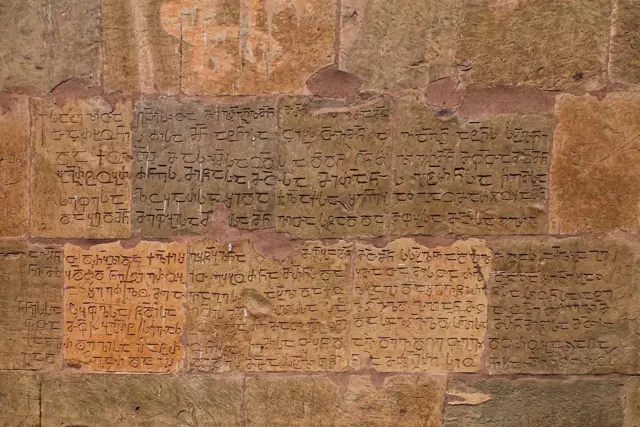
Another great treasure of Ateni Sioni is its inscriptions. Over many centuries hundreds of people left building, memorial, church and personal records on the interior and exterior walls of the church. As a result Ateni Sioni became a kind of unique archive of Georgian epigraphy.
Here there are examples of the asomtavruli, nuskhuri and mkhedruli scripts. Especially important are the early nuskhuri inscriptions dated to the 9th century and the mkhedruli inscriptions of the late 10th century, which are of special value for studying the history of modern Georgian writing.
The inscriptions preserved on the church walls do not contain only religious texts. Some of them give direct information about important events in Georgia's political history. That is why for historians Ateni Sioni is as important a written source as it is an architectural monument.
One of the historical inscriptions tells of the tragic events in Tbilisi in 853, when Bugha the Turk, general of the Abbasid caliph, marched against the emir of Tbilisi, Ishaq ibn Ismail. Tbilisi was taken and burned, and the emir was executed. The record of this event left on the church wall is an exceptional epigraphic witness to the history of medieval Georgia.
Other inscriptions are connected with Georgia's rulers and nobles. Among them is information about members of the Bagrationi family, which makes Ateni Sioni an important monument for the study of Georgia's state history as well.
In the 11th century the political and economic importance of the Ateni gorge also grew. An inscription connected with the age of King Bagrat IV tells of the building of a town and various structures at Ateni. This shows that in the Middle Ages a much larger and more active settlement existed around the church.
Near the church the remains of the fortified medieval settlement of Ateni and its fortress can still be found today. This setting confirms once again that Sioni was not an isolated village church: it was part of an important historical centre.
Natural conditions also gave the Ateni gorge special importance. The valley of the river Tana was known for centuries for its farming and winegrowing. Rocky slopes, forests and the terraces of historic vineyards formed a single cultural landscape around the church.
Over the centuries Ateni Sioni survived many hard periods in Georgia's history. Foreign invasions, regional wars, earthquakes and political conflicts affected the state of the church as well. At various times it was damaged and then restored again.
Despite these trials, the church's main architectural structure, a large number of ancient inscriptions and important fresco painting have survived to this day. It is precisely the presence of this varied heritage in one space that makes Ateni Sioni an especially valuable monument.
In the Soviet period, when the activity of the Church of Georgia was severely restricted, religious life at Ateni Sioni declined greatly. At the same time its scholarly study as an architectural, artistic and epigraphic monument increased.
After Georgia regained its independence, the spiritual life of the church revived again. Today Ateni Sioni is a functioning Orthodox holy place, visited both by believers and by people interested in Georgian art, architecture and history.
The special strength of Ateni Sioni lies in the fact that several of the greatest cultural layers of Georgian history come together in one small church: 7th-century architecture, medieval stone reliefs, 11th-century frescoes and Georgian inscriptions created over almost a thousand years.
Ateni Sioni is a place where stone, painting and the Georgian word become a single historical chronicle. Its façades preserve an early great achievement of Georgian architecture, its wall painting opens to us the spiritual world of medieval Georgia, and its inscriptions keep for us the voice of the people and events that lived on this land centuries ago.
Ateni Sioni still remains today one of the greatest treasures of Georgian Christian culture: a church where almost fourteen centuries of architecture, faith, art and the history of Georgian writing live in one holy space.